
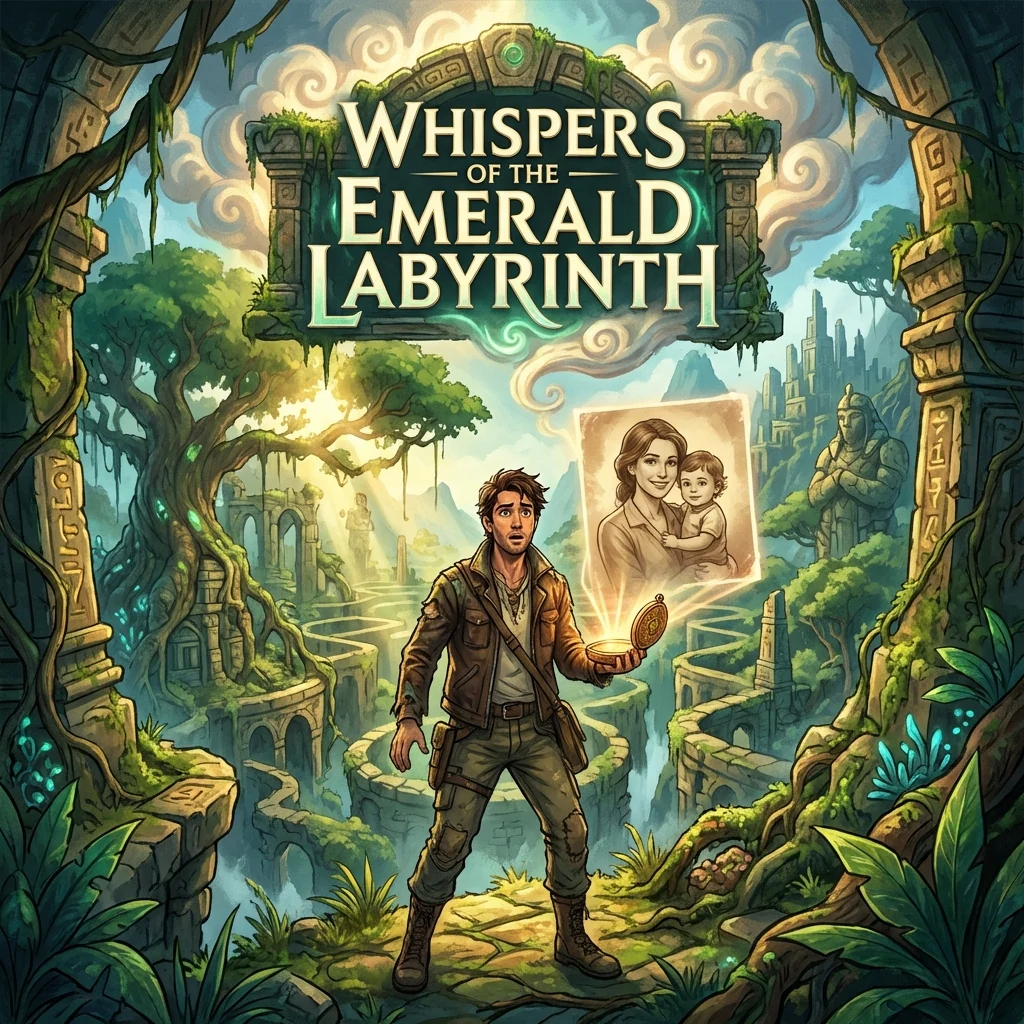
The dense canopy of the Amazon rainforest pressed down like a living shroud, sunlight fracturing into emerald shards that danced across the leaf-strewn ground. Elias Thorne wiped sweat from his brow, his machete rising and falling in rhythmic fury against the relentless vines. For weeks he had pushed deeper into this green hell, guided by a tattered map passed down through generations of his family, whispering of the Emerald Labyrinth—a lost city said to cradle the forgotten truth of humanity’s earliest stargazers. Scholars dismissed it as myth, but Elias felt it in his bones, a pull as primal as the river’s roar echoing in the distance.
He was alone now. The local guides had vanished three days ago, muttering prayers to jungle spirits and leaving him with only his backpack, a compass, and unyielding determination. The air hummed with life: the screech of macaws, the distant bellow of howler monkeys, the incessant drip of moisture from leaves overhead. Each step was a conquest, the mud sucking at his boots like greedy hands. But the awe never faded; every twisted root, every fleeting glimpse of iridescent butterflies, spoke of mysteries unfolding.
By midday, the terrain shifted. The undergrowth thinned, revealing moss-covered stones half-buried in earth. Elias knelt, brushing dirt away to uncover intricate carvings—spirals mimicking constellations, figures with outstretched arms toward the heavens. His heart raced. ‘It’s real,’ he breathed, tracing the lines with trembling fingers. The map had led true. Emboldened, he pressed on, the path widening into a faint trail flanked by colossal trees whose trunks bore more glyphs, glowing faintly in the dappled light as if alive.
Night fell swiftly, stars piercing the canopy like diamonds on velvet. Elias made camp in a clearing, flames crackling against the encroaching dark. As he pored over the map by firelight, a low rumble shook the ground—a landslide? No, the earth parting to reveal steps descending into shadow. Dawn found him at the threshold of the labyrinth’s maw, a yawning archway framed by emerald-veined stone, vines parting as if in welcome.
Descending, torch in hand, Elias entered a world apart. The air cooled, carrying scents of earth and ancient spice. Walls shimmered with bioluminescent fungi, casting an ethereal glow that illuminated bas-reliefs of celestial maps, comets streaking across depicted skies, and peoples gathered under vast observatories. He wandered corridors that twisted like veins, each chamber a revelation: altars etched with mathematical precision predating known civilizations, crystals aligned to capture starlight. Awe swelled in his chest, a profound sense of connection to something vast and timeless. This was no mere city; it was a testament to forgotten genius, a place where humans once touched the divine.
Hours blurred into a dreamlike haze. He climbed spiral staircases to balconies overlooking subterranean gardens where luminous flowers bloomed eternally. In one vault, he found star charts aligning perfectly with modern astronomy, predicting eclipses millennia ahead. ‘They knew,’ he whispered, voice echoing. ‘They saw what we couldn’t.’ The exploratory thrill coursed through him, erasing fatigue, hunger, fear. Obstacles mounted—a collapsed passage forcing detours, narrow ledges over bottomless chasms, faint whispers that seemed to guide or warn. Yet each hurdle unveiled greater wonders, the labyrinth unfolding like a story written in stone.
Deeper still, a grand atrium opened, its dome cracked but intact, depicting the birth of stars in vivid mosaic. Elias staggered, overcome. Here, surely, lay the heart. A pedestal bore a single object: a jade orb, smooth as glass. As he approached, it pulsed with inner light, projecting holographic visions—cities rising, skies parting for cosmic visitors? No, precise astronomical events, calendars cycling through eons. The forgotten truth: this civilization had mapped the universe before Babylon, their knowledge buried by cataclysm.
But the orb dimmed, leading his gaze to a shadowed alcove. There, amidst offerings, lay a simple locket, tarnished gold glinting. Compelled, Elias picked it up. It sprang open with a click, revealing a faded photograph: a woman with his eyes, holding a toddler version of himself, background a familiar glyph-walled chamber. His mother, missing for twenty years, presumed dead in a prior expedition. Gasps escaped him. Engraved inside: ‘Elias, my starborn son. Return when ready.’ Memory flooded—suppressed flashes of green glows, maternal songs in an unknown tongue, being carried through jungle night by strangers.
The walls seemed to breathe. Footsteps echoed—figures emerged from hidden doors, robed in emerald cloth, faces kind yet wary. Their leader, an elder with eyes like his mother’s, spoke in perfect English tinged with accent. ‘Welcome home, Elias. Your mother built this sanctuary after smuggling you out. The world above rejected our truths; she hid you to protect the bloodline.’ The journey recontextualized in an instant—not blind exploration, but an innate homing, clues planted in dreams and family lore by her emissaries. The map? Her handwriting. The whispers? Their calls.
He learned swiftly: the Labyrinth endured, guardians preserving star-knowledge against catastrophe. His mother had died years ago, but prophesied his return to lead. Awe deepened into belonging, the exploratory quest complete in revelation. Torn yet resolved, Elias chose to stay, vowing to bridge worlds one truth at a time. The jungle above faded to memory; here, under eternal stars, his true adventure began—and ended—in profound, transformative peace.