
The old cabin squatted at the edge of Blackwood Forest like a forgotten secret, its weathered boards groaning under the weight of endless rains. Elias Kane pulled his battered truck to a stop on the muddy drive, the engine coughing its last as he killed the ignition. He’d inherited the place from an uncle he barely remembered, a reclusive man who’d vanished years ago. ‘A fresh start,’ Elias muttered, grabbing his duffel bag and stepping into the downpour. The city had chewed him up—lost job, lost wife, lost everything. This was supposed to be solitude, healing.
Inside, the air hung heavy with mildew and dust motes that swirled in the weak beam of his flashlight. The furniture was shrouded in sheets, the fireplace cold and choked with ash. Elias lit a fire, the flames casting long, jittery shadows that seemed to retreat just beyond the light’s reach. He unpacked canned goods, a bottle of whiskey, and collapsed into a creaky bed upstairs. Sleep came fitfully, punctuated by the wind’s howl and the relentless patter on the tin roof.
That first night, he dreamed of eyes. Unblinking, pale orbs peering from the cracks in the walls, from the spaces between floorboards. He woke sweating, heart pounding, and scanned the room with his flashlight. Nothing. Just shadows playing tricks. ‘Get a grip,’ he told himself, draining the last of the whiskey.
Morning brought a deceptive calm. Sunlight filtered through grimy windows, revealing a sparse kitchen and a back door leading to the woods. Elias chopped wood, the axe biting satisfyingly into logs, sweat clearing his head. But as dusk fell, the unease returned. Sitting by the fire, he felt it—a prickle on his neck, the sense of being observed. He glanced at the windows; darkness pressed against the glass like ink. A shape flickered at the periphery, gone when he turned.
‘Animals,’ he reasoned. Raccoons, maybe deer. He nailed blankets over the windows for good measure and barred the doors. But sleep evaded him. Around midnight, a whisper slithered through the room. ‘Elias…’ Soft, like leaves rustling, but his name. He bolted upright, flashlight sweeping. Empty. The fire had died to embers, shadows thickening. He rebuilt it, flames roaring back, but the whisper lingered in his ears.
Day two, he explored. The forest path wound deep, trees crowding like sentinels. No signs of life—no birdsong, no tracks. Just silence, oppressive and watchful. Back at the cabin, he found the axe misplaced, blade facing the door. Had he left it that way? Paranoia crept in. Nightfall amplified it. The whispers grew bolder: ‘Why did you come? You shouldn’t be here.’ He shouted back, voice cracking. Grabbed the axe, patrolled the rooms. Shadows seemed to shift when he blinked, elongating, reaching.
On the third night, the shape returned. Clearer now, humanoid, hunched in the corner of the living room. Pale skin, eyes like voids. Elias froze, axe raised. ‘Who are you?’ No answer, just a low chuckle that vibrated the floor. It lunged as he swung—the blade passed through mist, clattering against the wall. The figure dissolved, reforming across the room, closer. Elias fled upstairs, barricading the bedroom door with the dresser. Through the keyhole, he saw it ascend the stairs, deliberate steps echoing.
Dawn saved him. The figure vanished with the light. Shaken, Elias searched the cabin. Under the stairs, a loose floorboard revealed a hidden compartment: a leather journal, yellowed pages filled with frantic scrawl. ‘Day 1: Uncle left this place to me. Felt eyes from the start.’ Elias’s blood ran cold—the handwriting matched his uncle’s, but the dates… recent. Impossible. He read on: accounts of whispers, shapes, the same terror. Last entry: ‘It’s not outside. It’s waiting for me to become it.’
Desperation fueled him. He packed the truck, journal clutched tight. But the engine wouldn’t turn. Battery dead, though he’d checked it yesterday. Rain lashed harder, thunder rumbling. As night clamped down, the whispers became a chorus: ‘Stay. Join us.’ Shapes multiplied—corners, under the table, behind the curtains. Elias swung the axe wildly, splintering furniture, but they evaded, laughing.
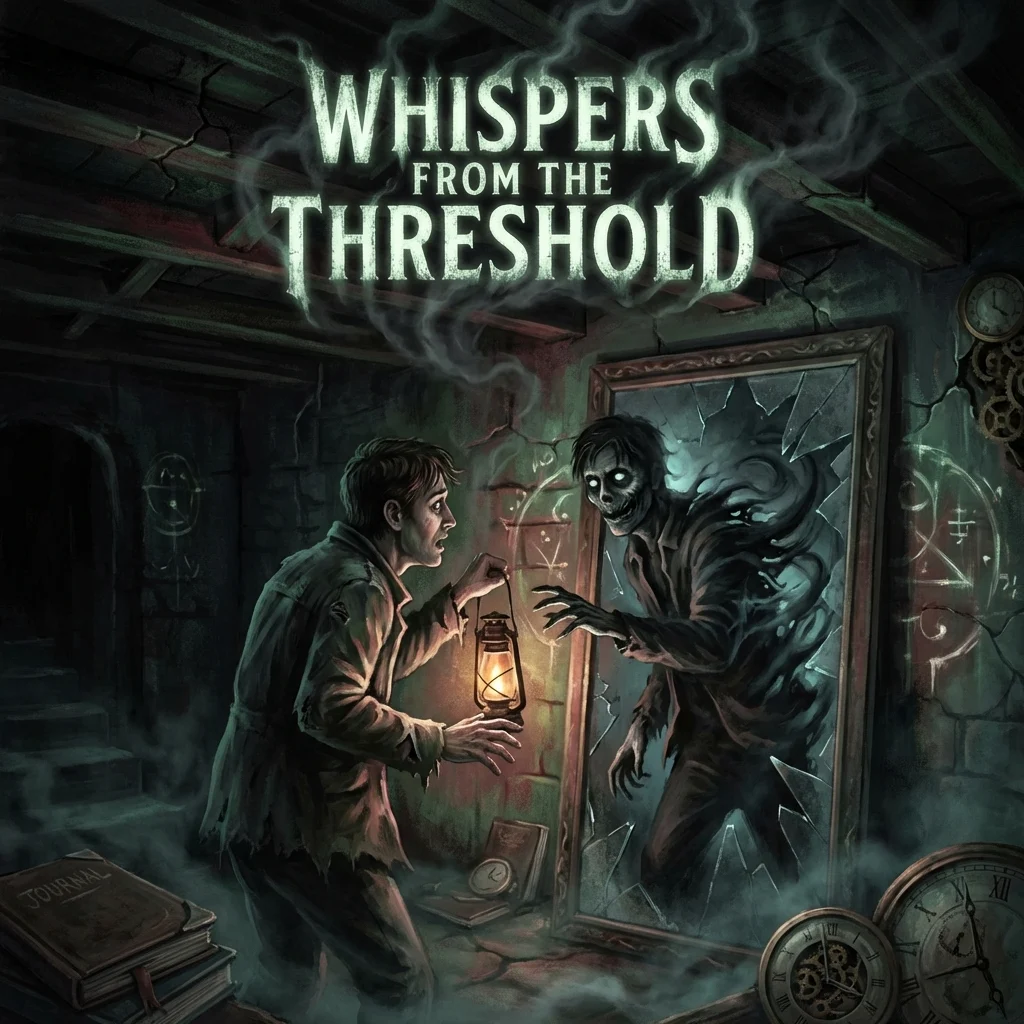
He retreated to the basement, a dirt-floored pit he’d overlooked. Flashlight beam caught crates, cobwebs… and a mirror, full-length, propped against the wall. His reflection stared back, haggard, terrified. But as he approached, the reflection didn’t mimic him. It smiled, eyes gleaming unnaturally. ‘Elias,’ it mouthed, voice syncing with the whispers. He smashed the mirror, shards exploding. Silence fell, broken only by his sobs.
Hours passed—or minutes? Time blurred in the dark. Footsteps above. The door creaked open, light spilling from the stairs. A silhouette descended: himself, axe in hand, face twisted in rage. ‘You disturbed it,’ the doppelganger snarled, voice his own. ‘Now you pay.’ Elias scrambled back, but the figure advanced inexorably.
In the struggle, the axe flew, embedding in the wall. Pinned, Elias gasped, ‘Who are you?’ The figure knelt, face inches away. ‘I’m you, Elias. The one who arrived three days ago. This cabin… it traps you. Copies you. The watcher isn’t a stranger—it’s the man before you, waiting to take your place.’ Memories flooded, recontextualizing everything: the inheritance was a lie; he’d driven here on impulse, no uncle. The journal? His own, from the previous loop. Every shadow, every whisper—echoes of past selves, building the chorus.
The doppelganger raised the axe. ‘One must die for the other to live. But you know the truth now: there is no escape. You’ll watch the next one, as I watched you.’ The blade descended, pain blooming, darkness swallowing.
But in that final moment, Elias understood. He wasn’t dying—he was becoming the watcher. Eyes opening in the dark corners, waiting for the truck’s rumble, the door’s creak. Eternal vigil, in the threshold between arrival and damnation.