
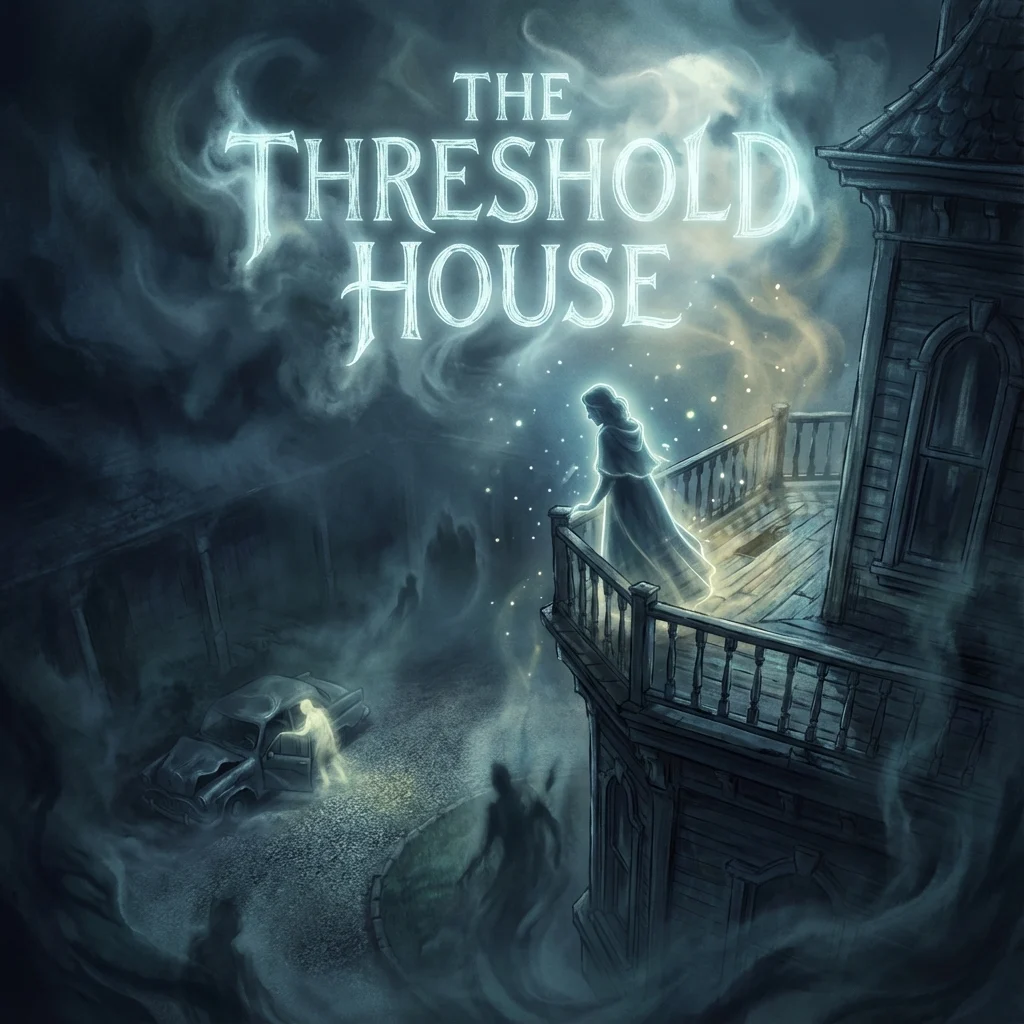
The fog clung to the coastal cliffs like a lover reluctant to let go, thick and impenetrable, muting the crash of waves below into a distant murmur. Clara Voss had driven three hours from the city, her old sedan rattling over potholed roads that snaked through barren moors, to reach Threshold House. It had been her family’s summer retreat when she was a child, a sprawling Victorian manor perched on the edge of the world, where the sea met the sky in an endless gray haze. Now, at thirty-eight, widowed and childless, she returned not for nostalgia but necessity. Her father had died six months ago, leaving the house to her in his will, along with a cryptic note: ‘The veil thins here. Beware what crosses.’
Clara dismissed it as the ramblings of an old man succumbing to dementia. She parked in the gravel drive, the tires crunching like brittle bones. The house loomed, its paint peeled by salt winds, windows like dark eyes watching her approach. Inside, the air was stale, heavy with the scent of damp wood and forgotten time. She flicked on lights powered by a wheezing generator, revealing faded wallpaper patterned with thorny roses, furniture shrouded in dust sheets.
That first evening, as she unpacked in the master bedroom overlooking the cliffs, the fog seemed to press against the glass, alive with subtle movement. Clara shook her head, blaming exhaustion. She cooked a simple meal in the cavernous kitchen, the flame of the gas stove flickering unnaturally low, as if the air resisted burning. Eating alone at the oak table scarred by generations, she felt the house settle around her, creaks and sighs echoing like breaths.
Sleep came fitfully. Dreams wove through her mind: her husband Mark, lost to cancer two years prior, whispering her name from the fog. She woke sweating, the room colder than before. Outside, the fog had thickened, swallowing the manor in its embrace. Morning brought no relief; sunlight struggled to pierce the veil, casting everything in diffused gray. Clara explored the house, room by room, cataloging for sale. In the library, she found her father’s journals, leather-bound volumes filled with meticulous notes.
‘The Threshold is no mere phenomenon,’ one entry read. ‘It is a wound in reality, where the boundaries between here and there fray. Shadows move without source. Voices call from empty rooms. I have seen them—loved ones gone, beckoning. But to answer is to step across, and not all return as they were.’ Clara’s hands trembled. Her father had always been prone to superstition, tales of ghosts and curses tied to the house’s foundations, built atop ancient barrows said to be gates to the underworld.
Days blurred into a slow unraveling. The fog never lifted, seeping through cracks, carrying whispers that mimicked Mark’s voice: ‘Clara… come closer…’ She told herself it was wind through the eaves, yet found herself drawn to the widow’s walk atop the house, a narrow balcony jutting over the abyss. From there, shapes coalesced in the mist—humanoid forms drifting just beyond sight, dissolving when stared at too long.
One afternoon, while sorting attic trunks, Clara uncovered a locket containing a faded photograph of her mother, who had vanished from the house twenty years ago during a storm. As she clasped it, a chill radiated from the metal, and in the dust motes dancing in the single bulb’s light, she glimpsed a woman’s figure, translucent, reaching out. ‘Clara,’ it mouthed, soundless. Heart pounding, she fled downstairs, slamming the attic door.
Nights grew worse. The house groaned as if in pain, floorboards warping underfoot. Clara lit every candle, their flames bending toward the windows. She dreamed of Mark again, his face gaunt, eyes pleading. ‘The veil is thin. Cross with me.’ Waking, she found wet footprints trailing from the back door to her bedroom—small, child’s feet, though she had no children.
Guilt gnawed at her, unbidden memories surfacing. Mark’s final days, her exhaustion from caregiving, snapping at him in frustration. The way she had prayed for release, selfishly. Was this punishment? The house feeding on her remorse? She tried to leave, packing the car one stormy morning, but the fog engulfed the drive, disorienting her. The road vanished; turning back, she found herself looping to the front door. Panic rising, she retreated inside.
Locals from the nearby village, when she finally reached it on foot through a momentary break in the mist, spoke in hushed tones. Old Mrs. Harrow at the pub: ‘Threshold House takes what it wants. Folk see their dead, hear ’em calling. Some walk into the fog and don’t come back. Your da tried to seal it, but the place fights back.’ Clara bought supplies, desperate for normalcy, but on the return, the fog whispered temptations: ‘Stay… join us…’
Back at the house, the manifestations intensified. Mirrors reflected not her image but crowds of spectral faces pressed against the glass from behind. Doors opened to blank walls or glimpses of other rooms—elegant parlors lit by gaslight, peopled by strangers in Victorian garb. Once, stepping through a pantry door, she emerged in the garden as it must have been a century ago, roses blooming unnaturally vivid, laughter echoing from unseen children. Seconds later, reality snapped back, leaving her chilled to the bone.
Her emotional tether frayed. Nights spent pacing, journal in hand, documenting the impossible, echoing her father’s obsession. ‘Is this madness?’ she wrote. ‘Or truth? The veil thins, and I feel myself thinning too.’ Mark appeared more vividly, materializing at the foot of her bed, solid enough to touch. His hand on hers was cold seawater. ‘I’ve waited,’ he said, voice like rustling leaves. ‘Cross over. It’s peaceful here.’
Clara resisted, barricading herself in the library, reading father’s final entries. ‘The Threshold does not connect life and death. It mirrors the soul’s regrets, conjures them to lure you deeper. To escape, face the lie at its heart.’ What lie? Her marriage’s strains? Mark’s illness? No—the deeper wound: as a child, she had watched her mother walk into the fog, too scared to call out, believing it a game. Her father’s accusations afterward: ‘You let her go.’
The fog invaded fully now, tendrils curling from vents, pooling on floors like milk. Clara climbed to the widow’s walk, Mark beside her—or his apparition. The sea roared below, invisible. ‘Jump,’ he urged. ‘We’ll be together.’ Figures emerged from the mist: her mother, smiling serenely; a child version of herself, beckoning. The air hummed with power, reality vibrating like a struck tuning fork.
In the final push, Clara screamed her confession into the gale: ‘I was afraid! I didn’t stop her!’ The apparitions faltered, Mark’s form flickering. But the twist came not in release, but revelation. As the fog parted briefly, revealing the cliffs’ jagged teeth, Clara looked down—not at waves, but at the manor grounds far below. There, sprawled on the gravel drive, was her car, crumpled against a tree, and beside it, her body, neck twisted unnaturally, eyes staring blankly at the sky.
She had died on arrival. The three-hour drive ended in a fog-blinded crash, her spirit drawn inexorably to the house, the place of her deepest regrets. The ‘days’ she experienced were timeless wanderings in the Threshold’s limbo. Mark, her mother—echoes conjured by her guilt, the house’s thin veil amplifying her soul’s fractures. Not a bridge to death, but a trap for the already dead, forcing confrontation with unfinished pain before release.
Understanding crashed over her like the waves she could no longer hear. The locals’ warnings? Memories fabricated by the Threshold to heighten torment. Her father’s journals? Her own subconscious scrawlings, looping eternally. To cross was oblivion; to face was freedom.
Clara—or what remained—turned from the edge. The fog recoiled, apparitions dissolving into shrieks. The widow’s walk solidified, stairs appearing downward. She descended, passing through walls that yielded like mist, emerging not into the house, but a soft light beyond. Mark’s true voice, faint from afar: ‘Let go.’
The manor stood empty once more, fog settling patiently, awaiting the next soul to thin the veil. Below, Clara’s body lay undiscovered, the house’s silent sentinel.