
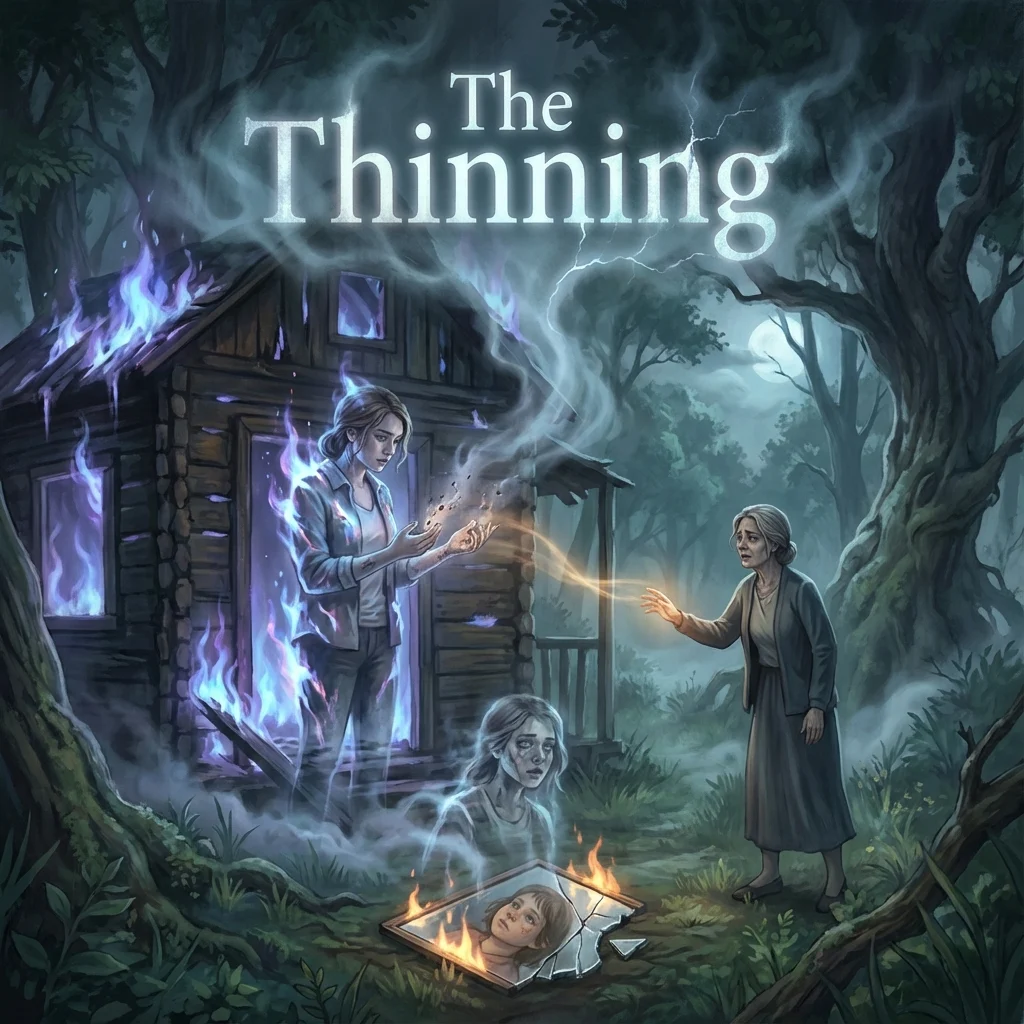
Elena gripped the steering wheel tighter as the narrow road twisted deeper into the ancient forest. The pines loomed like silent sentinels, their branches knitting together overhead to blot out the late afternoon sun. Her mother’s lawyer had insisted this cabin was the perfect retreat—a place to grieve, to find closure after the sudden heart attack that had claimed Margaret just two months prior. Elena hadn’t questioned it then; the city apartment felt suffocating, filled with echoes of her mother’s laughter and the scent of her chamomile tea. Now, with the GPS long dead and only a crumpled map for guidance, doubt crept in like the gathering mist.
The cabin appeared abruptly at the end of a rutted drive, half-swallowed by ivy and moss. Its slanted roof sagged under the weight of years, and the porch creaked ominously as she stepped out, suitcase in hand. The air was unnaturally still, heavy with the damp earthiness of decay and something sweeter, like overripe fruit. Inside, the door swung open with a groan, revealing a single room dominated by a stone fireplace. Dust-covered furniture huddled in the corners: a sagging armchair, a wooden table scarred by forgotten meals, a narrow bed piled with moth-eaten quilts. Faded photographs lined the mantel—strangers with stern faces, their eyes following her as she moved.
She busied herself that first evening, sweeping away cobwebs and building a fire from the dry logs stacked by the hearth. The flames crackled to life, casting flickering shadows that danced like hesitant spirits. Elena poured a glass of wine from the bottle she’d brought, sinking into the armchair with a sigh. For the first time in weeks, the knot in her chest loosened. This was isolation, yes, but the good kind—the kind that promised healing.
Sleep came fitfully. In the night, she dreamed of whispers threading through the walls, soft and insistent, like wind through cracks but forming words she couldn’t grasp. She woke to the patter of rain on the roof, though the sky outside was clear, stars pricking the velvet black. Shaking it off as cabin fever, she rose to stoke the fire and noticed the photographs. In the firelight, the faces seemed sharper, more alive—one woman with graying hair bore a striking resemblance to her mother, though younger, happier.
Morning brought a deceptive calm. Elena explored the property, following a overgrown path that hugged the edge of a sluggish creek. The forest pressed close, ferns brushing her legs, birdsong absent save for the occasional caw of a raven. She found a small clearing where the trees thinned, revealing a circle of flat stones arranged like an ancient altar. Kneeling, she traced the mossy carvings—symbols that twisted like veins, pulsing faintly under her fingertips. A chill ran through her despite the sun. ‘Old Native markings, probably,’ she muttered, but the unease lingered as she hurried back to the cabin.
That afternoon, as she chopped vegetables for stew, the mirror above the dry sink caught her eye. Her reflection stared back, pale and tired, but for a split second, it lagged—lips moving a heartbeat after hers, eyes darkening to an unnatural black. She blinked, and it was gone. Heart pounding, she avoided the glass for the rest of the day, focusing instead on the journal she found tucked behind a loose floorboard. Its leather cover was cracked, pages yellowed, written in her grandmother’s spidery hand. Entries spoke of ‘the thinning,’ a time when the veil between worlds grew porous, allowing glimpses of what lay beyond. ‘Do not linger here when it comes,’ one warned. ‘It hungers for the lost.’ Elena closed it with a snap, dismissing it as superstition born of isolation.
But the whispers returned that night, clearer now, murmuring her name—Elena, Elena—from the spaces between the floorboards. She bolted upright, flashlight beam sweeping the room. Nothing. Outside, the mist had rolled in thick, coiling around the cabin like ghostly fingers. In the beam’s glow, shapes moved within it—tall, elongated figures that dissolved when she focused. Sleep evaded her; she sat by the fire until dawn, the journal open on her lap, reading tales of family members who vanished during full moons, only to be heard calling from the woods years later.
By the second day, the anomalies escalated. The creek path led farther than before, the trees parting to reveal not forest but a vast, fog-shrouded plain where skeletal trees clawed at a bruised sky. Elena stumbled back, breath ragged, convinced it was a hallucination from bad air or grief. Back at the cabin, objects had shifted—the knife she’d left on the table now lay by the door, the quilts folded neatly though she hadn’t touched them. The photographs had changed too; the woman resembling her mother now smiled faintly, as if acknowledging Elena’s presence.
She tried to leave that afternoon, engine roaring to life, but the road looped impossibly back to the cabin after minutes of driving. Panic rising, she abandoned the car and plunged into the woods on foot, compass in hand. Hours passed—or minutes? Time smeared. Voices joined the whispers, familiar ones: her father’s gravelly laugh from childhood vacations, her mother’s soft humming. They beckoned her deeper, toward the stone circle, where the air hummed with energy.
Kneeling once more, Elena pressed her palms to the stones. The world tilted. Visions flooded her: alternate lives flashing by—a version of herself married with children, laughing in a sunlit park; another cowering in shadows, pursued by unseen horrors; her mother, young and vital, waving from the cabin porch. The voices coalesced into words: ‘Come back. You’ve lingered too long.’
Dazed, she staggered to the cabin as dusk fell. The door stood ajar, fire roaring unnaturally high. Inside, the room had transformed—a fourth wall materialized, revealing a hidden alcove with a child’s crib, scorched and collapsed. Memories stirred, buried deep: she was six, playing by the fire while mother cooked. A spark jumped, flames racing up the curtains. Screams, smoke, her mother’s arms pulling her close as the roof caved.
But she remembered surviving, fostered after, building a life in the city. Didn’t she?
The whispers swelled to a chorus, the mist seeping under the door. Shadows coalesced into forms—translucent figures circling her, faces of ancestors from the photographs. Her mother stepped forward, solidifying, eyes filled with sorrow and love. ‘Elena, my darling. It’s time.’
‘No,’ Elena whispered, backing away. ‘You’re dead. I came here to mourn you.’
Margaret shook her head, tears glistening. ‘I survived that night, barely. You didn’t. The fire took you, my little one. This cabin, this place where reality thins—it’s held your echo all these years. The life you thought you lived, the city, the job, my ‘death’… illusions bleeding through from my world, echoes I sent to comfort you, to guide you back.’
Elena’s mind reeled. The apartment? Friends? Her promotion last month? Fading like mist. Every visit here as an ‘adult,’ every loop of the road—it was her spirit clinging, refusing the beyond. The thinning hadn’t weakened; she’d fed it with denial.
The figures closed in, gentle hands extended. ‘Let go,’ her mother urged. ‘The veil mends. Come home.’
As the cabin dissolved around her, Elena reached out, the illusions shattering like glass. Peace washed over her at last, the whispers silent, the mist parting to reveal infinite light beyond.