
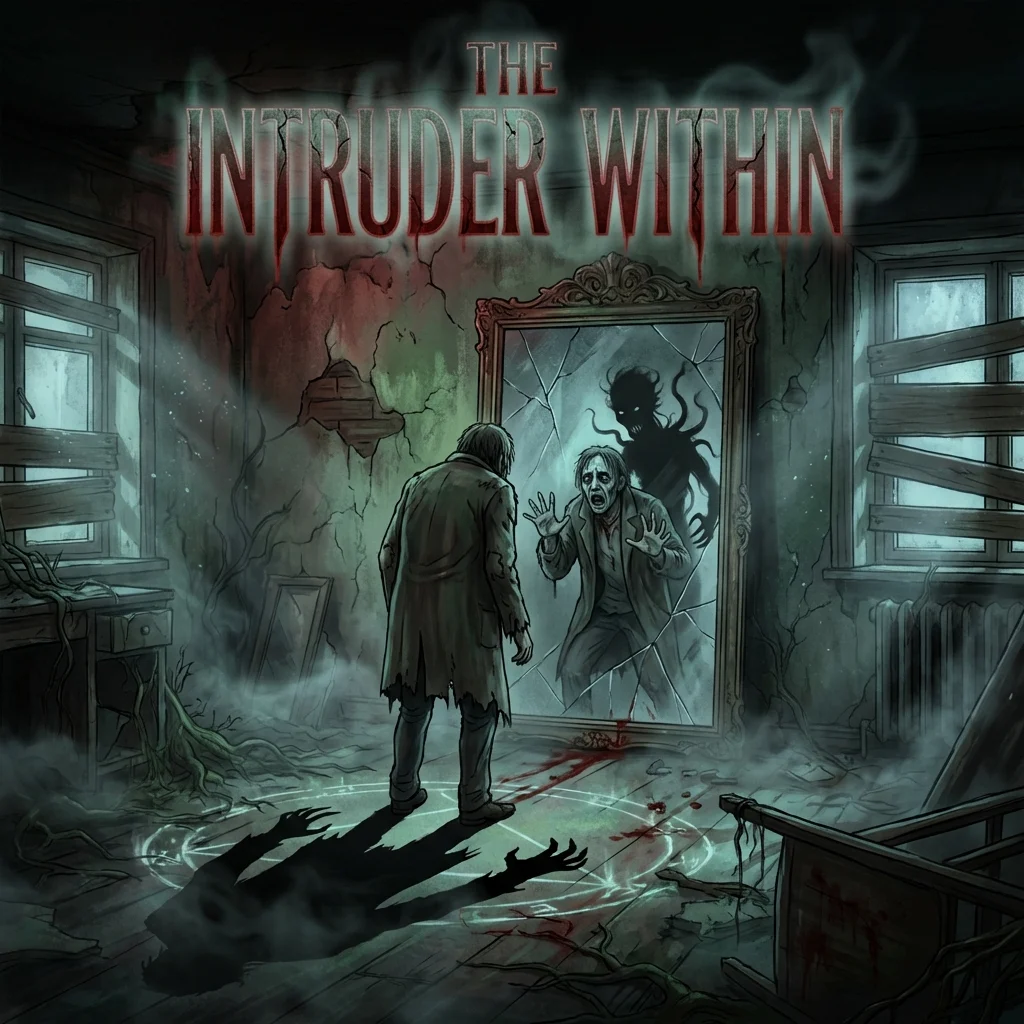
The old Victorian house creaked under the weight of autumn rain, its shadows lengthening as dusk bled into night. Alex Harlan sat at his cluttered desk, fingers hovering over the keyboard, chasing words that slipped away like smoke. He was a writer—or so he told himself these days—holed up in this inherited relic after the divorce, seeking solitude to birth his next novel. But lately, the solitude felt less like a choice and more like a cage.
It started small. A twitch in his left hand as he typed, the pinky finger curling inward against his will, as if testing its autonomy. He shook it out, blaming the chill seeping through the cracked windowpanes. Then came the mirrors. The one in the hallway, antique with a gilded frame, held his gaze too long one evening. He raised his arm to brush back his disheveled hair; the reflection hesitated, a split-second lag, before mimicking him. A trick of light, he reasoned, rubbing his eyes. Fatigue from endless nights, the gnawing isolation.
But the lags persisted. In the bathroom mirror the next morning, his reflection’s smile came a beat after his own, lips stretching unnaturally wide. He smashed the glass with his fist, shards raining into the sink, blood welling from a shallow cut. The pain grounded him, sharp and real. ‘Get a grip,’ he muttered, bandaging the wound. Yet as he stared at the fractured remnants, he swore one sliver showed eyes that weren’t his—darker, hungrier.
Days blurred into a haze of unease. His hand betrayed him more often now: reaching for a glass of whiskey when he’d sworn off it, or tracing idle patterns on his thigh that felt foreign, intimate in a way that turned his stomach. Whispers began, faint at first, like wind through the eaves but forming words in his own voice. ‘Why fight it?’ they’d murmur during quiet afternoons. ‘This body is mine now.’ He blasted music to drown them, paced the creaking floors until exhaustion dropped him into fitful sleep.
Sleep brought no respite. Dreams of submersion, of being squeezed into a tight, pulsing space, watching through fogged glass as another moved his limbs. He’d wake drenched in sweat, heart hammering, convinced something watched from the corners of the room. Shadows seemed thicker there, pooling unnaturally, and once, in the dead of night, he caught a glimpse—a silhouette matching his own, hunched in the wardrobe’s ajar door. He slammed it shut, barricaded it with a chair, but the whispers chuckled softly.
Paranoia festered. He stopped looking in mirrors altogether, draping cloths over them, living by feel and memory. But his body rebelled harder. Walking to the kitchen, his legs buckled mid-stride, forcing him to knees as if dragged by invisible strings. Pain lanced through his joints, bones grinding like they no longer fit. In the dim light, he saw his skin ripple, subtle waves under the flesh of his forearm, as if something burrowed beneath.
He tried to flee. The car keys jangled in his trembling grip, but the engine sputtered and died, battery drained despite full charge that morning. Phone lines hissed static, no dial tone. Trapped. The house, once sanctuary, closed in with claustrophobic weight, walls groaning as if breathing. That night, the whispers grew bold. ‘Remember the crash,’ they said, his voice but laced with malice. ‘You weren’t driving. I was.’ Flashes assaulted him: screeching tires, shattering glass, a body slumped beside him—not his wife, but something wearing her skin? No, lies. Hallucinations from stress.
By week’s end, revulsion consumed him. His reflection—caught unavoidably in a window—showed pallid skin stretched too tight, veins threading black beneath. His left hand, now fully autonomous, clawed at his face when he slept, leaving bloody furrows. He bound it with rope, but it writhed against the restraints, fingers elongating unnaturally, nails sharpening. Hunger gnawed not in his belly, but deeper, a ravenous pull toward the butcher knife block.
Desperation peaked on the seventh night. Rain lashed the windows like accusations. The hand freed itself, seizing the largest cleaver from the drawer. It raised high, aiming for his throat, but he wrested control just enough to turn the blade inward. With a guttural scream, he hacked at his wrist, severing tendons, bone crunching under the edge. Blood sprayed, hot and coppery, pooling on the floorboards. The hand flopped free, twitching, then skittered across the wood like a pale spider, nails clicking.
Agony blurred vision, but triumph surged. He cauterized the stump with the stove’s flame, teeth gritted against blackout waves. The severed hand crawled toward the basement stairs, vanishing into shadows. Silence fell, blessed and eerie. For the first time in days, his body felt his own—cleaner, lighter.
Dawn crept in gray fingers. Weak from blood loss, he bandaged the stump, scavenging painkillers from the cabinet. Memories sharpened, unclouded. The crash ten years ago: he’d been alone, driving home drunk from a book signing. No wife—divorce was later fiction. But the accident… he’d swerved to avoid a figure in the road, a hitchhiker perhaps. Impact. Then darkness.
Waking in hospital, whole but changed. Doctors puzzled over his ‘miraculous recovery,’ no internal injuries despite the wreck’s ferocity. He’d dismissed their concern, eager to write again. But now, clarity pierced: that hitchhiker hadn’t died. It had burrowed in, latched to his nerves, his mind, puppeteering from within. The lags, twitches, whispers—they were the intruder’s control slipping as his true body rejected the parasite.
The stump throbbed, but beneath the pain, a new sensation: growth. Flesh knitting faster than natural, bone extending. He stumbled to the basement door, drawn inexorably. The severed hand lay there, fused to a larger mass—his own arm regenerating, pushing out the tainted flesh. But worse: the whispers returned, not from within, but from the stump’s emerging mouth? No.
Horror crested as full recollection slammed home. He wasn’t rejecting the intruder—he was the intruder. The hitchhiker, mangled in the crash, desperate to survive. He’d crawled into the dying driver’s open skull through a laceration, devouring neurons, weaving into the brain. Alex Harlan had perished that night, his body hijacked. The ‘twinges,’ the ‘lags’—they were the host’s remnant consciousness stirring, the original mind fragments fighting to resurface, expelling the squatter.
The new hand burst forth fully formed, gripping his throat with crushing force. But it was Alex’s hand, real Alex, eyes—his eyes in the basement mirror across the room—locking on with recognition. ‘My body,’ the true Alex’s voice rasped from his own lips, no longer whispers but command. The parasite self watched helplessly as the host reclaimed limb by limb, memories flooding back: wife killed by the drunk driver (him), children orphaned, life stolen.
The last expulsion came as vomit—black, writhing tendrils spewing from his mouth, collapsing into a mewling heap on the floor. The true Alex gasped, standing tall, body purified. He stared down at the parasite’s final form: a humanoid lump, features mirroring his own but twisted, pleading silently.
With calm resolve born of ten years’ imprisonment, Alex raised the cleaver. The house fell silent at last, save for the rain.