
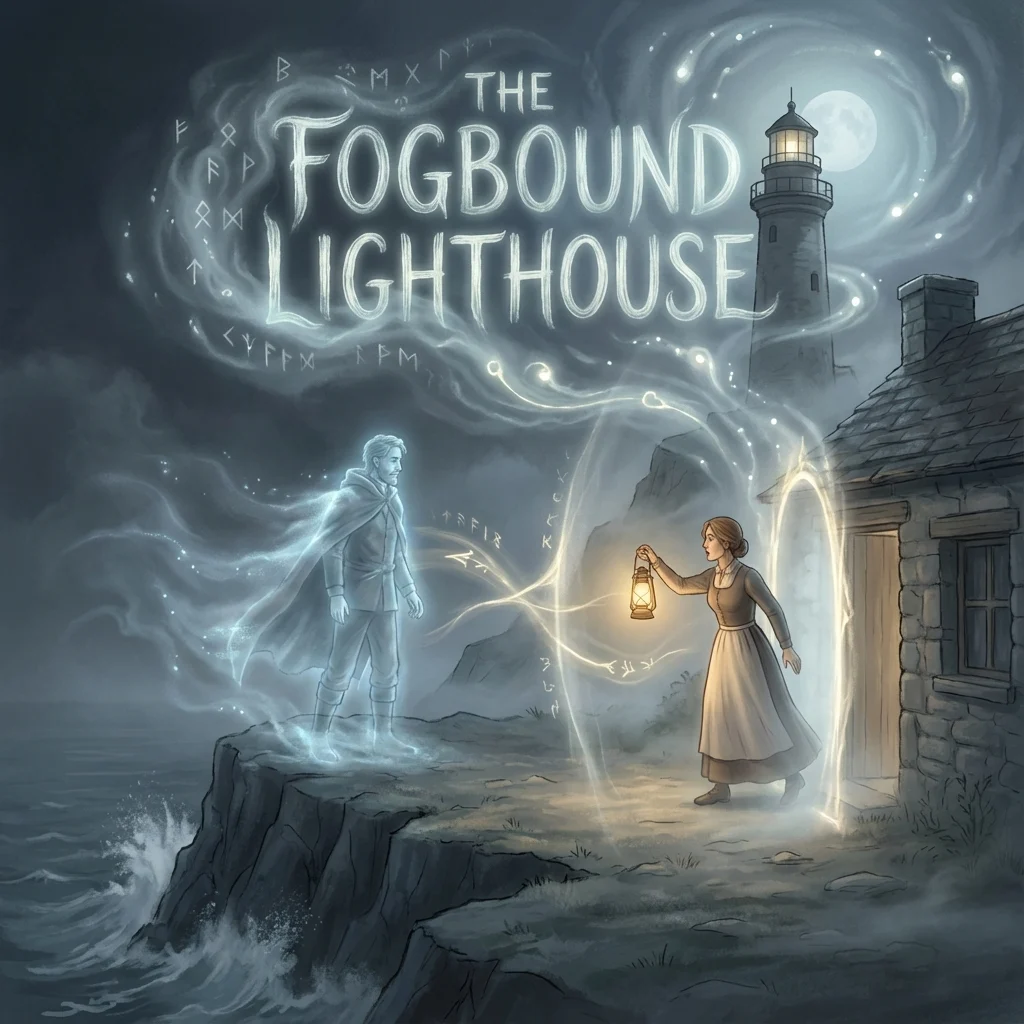
The fog came first, as it always did on the cliffs of Dunmere Point. Elias Kane gripped the steering wheel of his battered Jeep, the wipers slashing futilely against the thickening mist that seemed to seep from the sea itself. It had been a year since Clara’s accident—twelve months of hollow days and nights haunted by the echo of her laughter, the scent of her lavender soap. He had promised her they’d return to the lighthouse cottage someday, away from the city’s clamor, to recapture the magic of their honeymoon. Now, that promise felt like a tether pulling him back to this forsaken edge of the world.
The cottage emerged from the gloom like a specter, its whitewashed walls peeling, the lantern tower dark and skeletal against the slate sky. Elias parked and stepped out, the salty wind whipping his coat. The air hummed with an unnatural stillness, broken only by the distant crash of waves far below. Locals whispered about Dunmere Point—a place where reality thinned, where the veil between worlds frayed during the fogs. Fishermen avoided it, speaking of lost time, glimpses of the departed. Elias had laughed it off back then, during those sunlit days with Clara. Now, grief had eroded his skepticism.
Inside, the cottage smelled of damp stone and faded memories. Dust motes danced in the beam of his flashlight as he lit the old oil lamps. The furniture was as they left it: the sagging sofa where they’d made love, the kitchen table scarred from late-night games. He unpacked sparingly—a bottle of whiskey, her photo, his camera. Photography had been their shared passion; Clara behind the lens, capturing Elias in moments of unguarded joy. Now, the camera felt like a relic, heavy with absence.
That first night, sleep evaded him. He lay on the bed, staring at the ceiling beams etched with their carved initials: E + C forever. The fog pressed against the windows like curious fingers. Around midnight, a soft creak sounded from the hallway. Elias bolted upright, heart pounding. ‘Clara?’ he whispered, the name tasting like ash.
Nothing. Just the house settling, he told himself. But as he drifted off, dreams wove in: Clara’s face, pale and smiling, beckoning from the cliff’s edge. She wore the white dress from their wedding, her hair unbound by the wind.
Morning brought no relief. The fog lingered, muting the world to grays and whites. Elias wandered the cliffs, camera slung over his shoulder. The path to the lighthouse was overgrown, nettles snagging his jeans. At the tower’s base, he paused, remembering how Clara had dared him to climb it, her laughter ringing as they spun in the lantern room, kissing amid the salt spray.
He snapped photos: the mist-shrouded sea, jagged rocks below, the cottage dwarfed by infinity. But through the viewfinder, something shifted—a flicker of white at the periphery. He lowered the camera, scanned the emptiness. Imagination, grief’s cruel joke.
Back inside, he poured whiskey, the burn steadying his nerves. He pored over old albums, fingers tracing Clara’s image. The accident replayed unbidden: their argument over his long hours at the studio, her storming out into the rain-slicked night. The call at dawn: wreckage on the highway, her gone. Guilt gnawed— if he’d chased after her, begged forgiveness…
Dusk fell early, the fog thickening into an impenetrable shroud. Elias lit candles, their flames guttering. Whispers began then, faint as sea foam: his name, murmured on the wind. He froze, glass midway to his lips. ‘Who’s there?’ Silence answered, but the air grew heavy, charged with unseen presence.
He stepped onto the porch, the wooden boards groaning underfoot. The world beyond dissolved into swirling vapor. A shape materialized—a woman in white, standing at the cliff’s brink. Clara. Elias’s breath caught. ‘Clara?’ He stumbled forward, the ground slick.
She turned, her face luminous in the gloom, eyes deep pools of sorrow. ‘Elias,’ she sighed, voice carried on the breeze, both near and far. ‘Why did you come back?’
‘I had to. To find you. To say I’m sorry.’ Tears stung his eyes. She reached out, her hand translucent, brushing his cheek with chill.
‘The fog… it calls to the unfinished,’ she whispered. ‘Our love, our fight. It binds us here.’
They talked through the veil—memories spilling like tidewater. She forgave him, her touch lingering. Elias felt peace, a melancholy warmth seeping into his bones. But unease prickled; her form wavered, the fog curling possessively around her.
Night deepened. The whispers multiplied, voices overlapping: lovers lost, sailors drowned, regrets eternal. Elias barricaded the door, but the cottage shifted. Walls breathed, furniture rearranged subtly—a chair by the window now faced the sea, as if waiting.
He dreamed vividly: reliving their honeymoon, but twisted. Clara aged before him, wrinkles etching her joy into pain, then youth restored in cycles. He woke sweating, the sheets tangled.
Days blurred. Or were they hours? Time slipped in the thin place. Elias photographed obsessively, capturing anomalies: shadows with no source, clocks frozen at 3:17—the hour of the crash. Clara appeared more frequently, solidifying. They embraced, her form yielding like mist-made flesh. Passion reignited, feverish and desperate, on the very bed of their youth. Yet each parting left him weaker, hollowed.
‘This place feeds on us,’ she warned one twilight, as they sat by the hearth’s dying embers. ‘The thin veil— it hungers for stories unresolved. If we stay, we’ll fade into it forever.’
‘Then come with me. We’ll leave together.’ He clutched her hands, now warm.
She shook her head, eyes glistening. ‘I can’t. The accident… it was me who crossed first. You’re still tethered to life. But the fog pulls you closer.’
Confusion warred with longing. Was she pulling him, or warning away? The melancholy deepened, an unsettling ache in his chest.
On the fifth night—or was it the first?—the fog peaked, a roiling mass that swallowed the stars. Elias, drawn inexorably, climbed to the lantern room. Clara waited, radiant. ‘Join me, Elias. Forever.’
He teetered on the threshold, wind howling. Visions assaulted: their life montage—wedding, travels, the fight, sirens wailing. Then, a fracture in the fog: another figure approaching the cottage below, a woman in modern coat, flashlight bobbing.
Elias blinked. The figure climbed the porch, entered. Inside the lantern glass, parallel to him, she moved through the rooms—touching furniture, weeping. It was Clara. Alive. Older, lines of grief etching her face. She lit lamps, poured whiskey, spoke his name.
Understanding crashed like waves. He wasn’t the visitor. He was the echo. The accident had claimed him, not her. His memories reconstructed in the thin place, convincing him of survival. Clara came yearly, anniversary pilgrim, communing with his spirit, her guilt manifesting their dialogues. He was the presence crossing worlds, haunting her visits, feeding the veil with their shared sorrow.
Clara—real Clara—stood now in the cottage, staring up at the tower. ‘Elias, I know you’re here. This year, let go. Live through me.’ Her voice pierced the fog, raw with pain.
Phantom Clara beside him dissolved, a sigh escaping. ‘She speaks truth. You’ve lingered too long, my love. The thin place held you for her forgiveness. Now, forgive yourself.’
Elias—no, his spirit—reached out, not to the phantom, but through the veil. He saw their life anew: his recklessness in the rain, swerving to avoid her departed car, the crash his alone. No guilt for her to bear.
With a final glance at the living Clara below, smiling through tears as if sensing release, he stepped into the fog’s heart. The world thinned to nothing, then expanded into light. Peace, true and unbound, washed over him.
Down in the cottage, Clara felt the shift—the air lightened, whispers silenced. She gathered his photo, stepped into the dispersing fog. For the first time in a year, the cliffs felt solid, the sea merely sea. She walked to the Jeep—hers now—and drove away, the lighthouse fading in the rearview, its secrets sealed.
The fog lifted by dawn, Dunmere Point ordinary once more.