
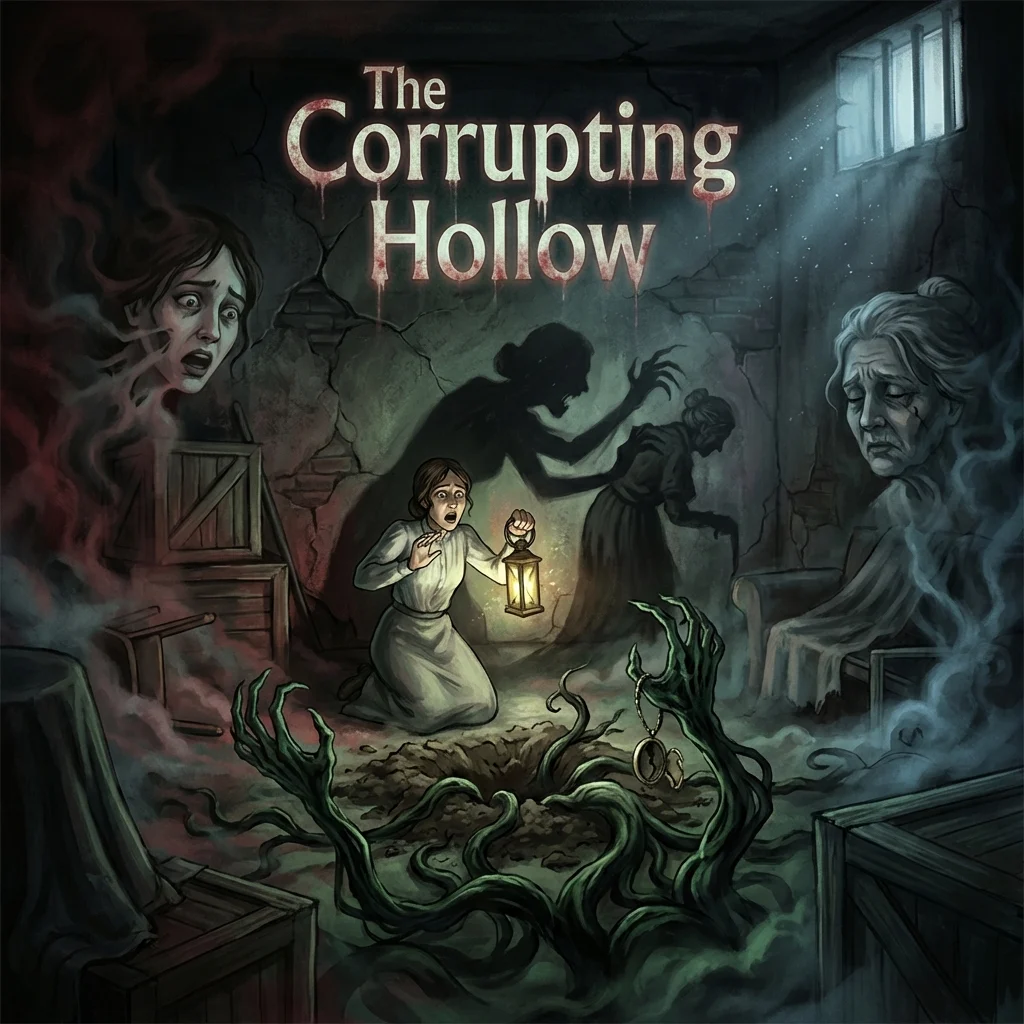
The old house on Elm Street had stood empty for decades, its windows like empty eye sockets staring out at the sleepy town of Harrow’s End. When Clara inherited it from her estranged aunt, she saw it as a fresh start. Freshly divorced, jobless, and adrift at thirty-five, the isolation promised solace. ‘A place to rebuild,’ she told her few remaining friends as she packed her bags.
The first night was unremarkable. The air smelled of dust and faint mildew, but Clara was too exhausted to care. She collapsed into the master bedroom’s four-poster bed, the sheets yellowed but soft. Sleep came quickly, dreamless.
Morning brought the first unease. Sunlight filtered through grimy panes, casting long shadows that seemed to linger too long after she moved. Clara shook it off, blaming the unfamiliar surroundings. She spent the day cleaning, hauling boxes up creaky stairs, wiping down surfaces caked in grime. By evening, her muscles ached pleasantly, and she felt a spark of accomplishment.
That night, the whispers began. Soft at first, like wind through cracks, but forming words she couldn’t quite catch. Clara bolted upright, heart pounding. The room was silent. She laughed nervously, attributing it to the house settling. But as she lay back down, the shadows on the wall opposite her bed shifted—not with the moonlight, but independently, coiling like smoke.
Days blurred into a routine. Clean, unpack, ignore the oddities. A door left ajar would close itself with a sigh. Footsteps echoed in empty halls when she was alone downstairs. Clara’s appetite waned; food tasted ashen. Her reflection in the hall mirror showed pallor creeping into her cheeks, eyes ringed with unnatural darkness. ‘Stress,’ she muttered, avoiding her own gaze.
On the fifth day, she found the first mark. Scratching her arm absentmindedly, her nails drew blood from a gash she didn’t remember. It was fresh, ragged, as if clawed by something feral. Panic flickered, but she bandaged it, telling herself she’d caught it on a nail while unpacking.
The whispers grew bolder, resolving into phrases. ‘Stay… join us… home.’ Clara’s sleep fractured into nightmares of being buried alive, walls closing in, her screams muffled by earth. She woke sweating, convinced the bed had sunk deeper into the floor.
Desperate for normalcy, she invited her old friend Marcus over. He arrived with pizza and beer, his easy laugh a balm. ‘This place is a time capsule,’ he said, exploring the parlor with its faded wallpaper peeling like skin. Clara smiled tightly, but as they talked, she felt it—a pressure building behind her eyes, an itch under her skin.
Marcus noticed her scratching. ‘You okay? You look… off.’ She waved it off. But when he stepped into the kitchen for more drinks, Clara’s vision tunneled. A rage bubbled up, unbidden. ‘He’s too loud. Too alive. He doesn’t belong.’ Her hand gripped the knife block before she realized. Horrified, she dropped it, the clatter echoing.
Marcus returned, concerned. ‘Clara? What happened?’ She forced a smile, but the whispers chanted now: ‘Take him. Make him like us.’ That night, after he left, she sobbed in the shower, scrubbing until her skin rawed. New scratches appeared on her legs, deeper.
She tried to leave. Packed a bag, started the car. The engine sputtered, died. Back inside, the front door wouldn’t budge, warped in its frame. Windows stuck fast. ‘Just the humidity,’ she gasped, but dread coiled in her gut.
Research became obsession. In the attic, amid moth-eaten trunks, she found letters. The house had a history: built in 1892 by Elias Crowe, a recluse who vanished after guests reported ‘changes’—guests who never left, their names scratched from records. Insanity, disappearances, whispers of a ‘hollowing.’ Clara’s aunt had been the last owner, found desiccated in the basement, cause of death ‘unknown.’
Her body betrayed her now. Fingers stiffened into claws at night, tracing symbols on the walls that glowed faintly before fading. Hunger gnawed, not for food, but something warmer, vital. Dreams showed previous residents: hollow-eyed figures shambling through halls, flesh sloughing, begging her to join.
Clara barricaded herself in the bedroom, rocking, whispering prayers. The walls breathed, in and out, syncing with her labored gasps. Plaster cracked, oozing a viscous fluid that smelled of copper and decay.
On the fourteenth night, the corruption peaked. She stumbled to the basement, drawn inexorably, body moving on puppet strings. The stairs groaned underfoot. At the bottom, amid cobwebs and rusted tools, lay a pit—freshly dug, dirt piled beside. But it wasn’t empty.
Bones gleamed white, human, arranged in a circle. In the center, a locket—hers, from childhood, lost years ago. Engraved: ‘To Clara, love Aunt Edith.’
Horror dawned as memories flooded, twisted. Not inherited. She’d killed Aunt Edith here, as a teen runaway, in a fit of rage over rejection. Buried her in the basement, took the deed, lived elsewhere, returned now to ‘inherit’ her own lie.
The house hadn’t corrupted her. It had waited, patient, feeding on the lie until truth rotted her from within. The scratches? Her own nails, subconscious guilt manifesting. Whispers? Her aunt’s voice, echoing in the walls she bricked over.
Clara—no, the husk—screamed as skin split, revealing hollow beneath. The pit yawned, welcoming. Outside, the town slept unaware, the house’s eyes watching for the next ‘heir.’