
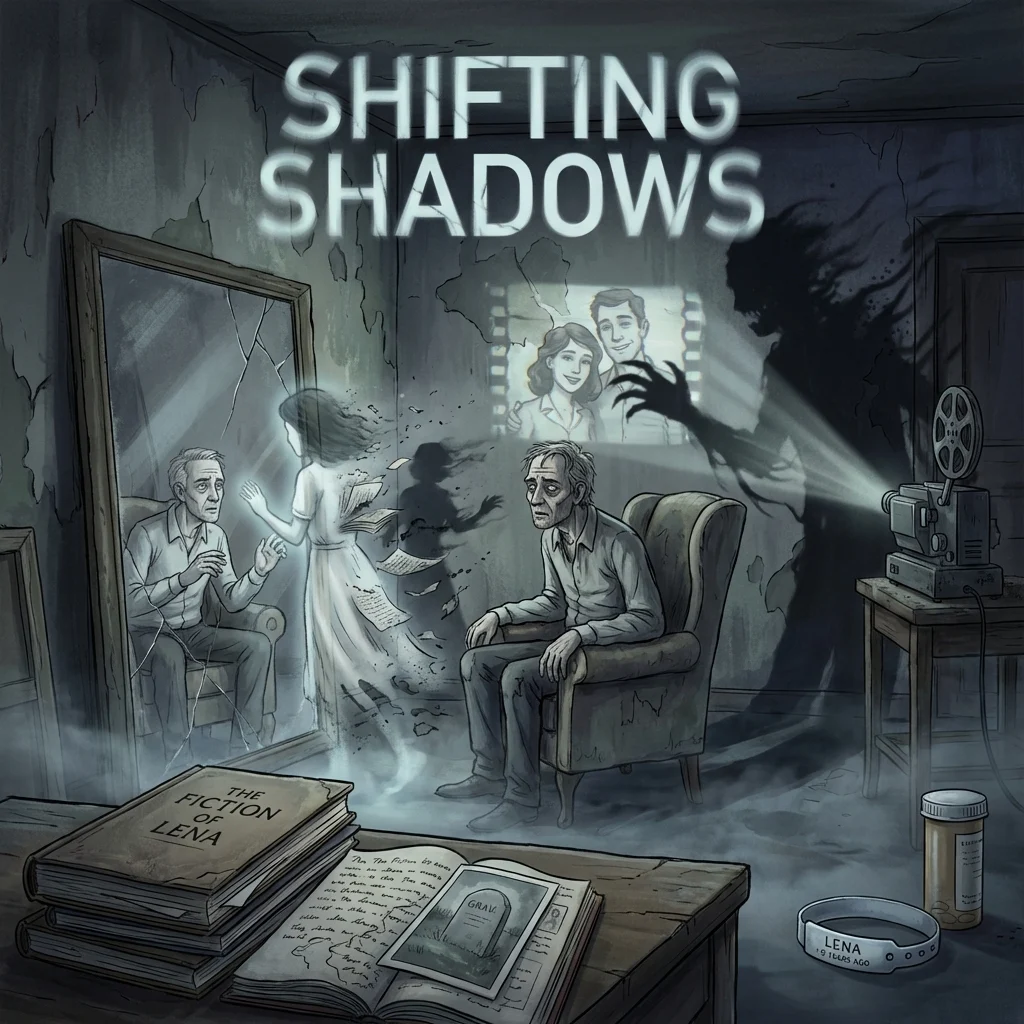
The mirror lied to him every morning, reflecting a man he barely recognized. Elias stared into his own eyes, searching for the truth buried in the lines of his face. Forty-seven years old, or was it forty-eight? The number slipped away like sand through fingers. He turned away from the glass, the bathroom’s fluorescent hum buzzing in his ears like an accusation.
Downstairs in the kitchen, the coffee maker gurgled its daily ritual. Elias poured a cup, black and bitter, matching the knot in his chest. Memories flooded in unbidden—Lena’s laugh echoing through this very room, her hands kneading dough for bread on Sunday mornings. They had been happy once, hadn’t they? Before the fights, before the silences that stretched into nights. Before she left.
He sank into the chair by the window, watching the street outside where leaves skittered in the autumn wind. The house felt too large now, emptier than it should. Five years since Lena packed her bags. Or was it the accident? The recollection twisted. One version had her slamming the door, tears streaming, vowing never to return. Another had screeching tires, shattered glass, her body crumpled on the roadside because he’d insisted on driving after that dinner where he’d drunk too much. Which was it? Elias pressed his palms to his temples, willing the fog to lift.
Work helped anchor him. As a librarian in the small town of Willow Creek, he spent days surrounded by stories that stayed fixed on pages. Unlike his own, which shifted like shadows at dusk. He shelved books methodically, inhaling the musty scent of paper, a comfort amid the chaos in his head. Patrons came and went—Mrs. Hargrove with her romances, young Timmy asking for adventure tales—but Elias kept to himself, smiling politely while his mind replayed fragments.
That evening, fragment: Lena’s voice, soft and pleading. ‘Elias, talk to me. What’s wrong?’ His response, sharp as a blade: ‘Nothing you can fix.’ Had he pushed her away? Or had he held on too tight? He pulled out the old photo album from the shelf, dust motes dancing in the lamplight. There she was: golden hair, green eyes sparkling. Wedding day, 1998. But wait—the date on the photo said 1999. A discrepancy, small but insistent, like a crack in a dam.
Sleep brought no respite. Dreams wove Lena into nightmares. She stood at the edge of a cliff, arms outstretched, calling his name. He reached, but his feet were rooted. Woke sweating, heart pounding. The clock read 3:17 AM. Always 3:17. Why that time?
Days blurred into weeks. Elias began noting his memories in a journal, desperate to pin them down. Entry one: Wedding in the park, rain threatening but holding off. Lena in white lace. Entry two: Honeymoon in the mountains, cabin by the lake. But later, entry ten: Honeymoon in Paris? No, that couldn’t be. He flipped back, handwriting his own yet foreign. Panic clawed at his throat.
He avoided the mirror now, shaved by feel. At work, a new book caught his eye—’The Unreliable Narrator,’ a psychological thriller about a man whose memories betrayed him. Elias bought it, read voraciously. The protagonist discovered his perfect wife never existed. Coincidence, he told himself, slamming the book shut.
Isolation deepened. He stopped answering the phone, ignored the mail piling up. Walks at night became ritual, streets empty under sodium lamps. One night, he saw her—Lena, crossing the park. Heart racing, he followed. She turned a corner, vanished. Was it her perfume on the wind? Lilac and vanilla. Or imagination?
Back home, he tore through drawers for proof. Letters tied with ribbon: ‘My dearest Elias, I miss you already. Paris was magic.’ Paris? He burned them in the sink, flames licking paper, acrid smoke filling the kitchen. Lies, all lies. His mind or hers?
The tension built, a slow coil in his gut. He barely ate, lost weight, cheeks hollowing. Colleagues noticed. ‘You okay, Elias?’ ‘Fine,’ he muttered, retreating into stacks. But doubt festered. What if the accident was his fault? What if he drove her to it?
One rainy afternoon, he found the box in the attic—Lena’s things, untouched. Inside, a diary, leather-bound. His hands trembled opening it. Pages filled with her script: ‘Elias is distant again. I fear he’s slipping away.’ Dates matched his memories, almost. But the last entry: ‘Today I leave for good. Can’t live with the ghosts anymore.’
Ghosts. The word echoed. Elias clutched the diary, descending stairs. In the living room, he sat, reading by flashlight as storm raged outside. Entries grew frantic: ‘He doesn’t remember our anniversary. Doesn’t remember me.’
Midnight. He couldn’t breathe. Stood, paced. Mirror in hallway beckoned despite his fear. He faced it. The man staring back—older, grayer. But behind him, in the reflection, a shadow? No. Just empty room.
Exhaustion won. He collapsed on the couch, diary open on chest. Dreams came fierce: Lena’s face morphing into his own, laughter turning to screams.
Morning light pierced curtains. Elias woke, head throbbing. The diary lay beside him, but now he noticed—the handwriting was his. Every page. Panic surged. He rifled through the box: photos, all of solo trips, faces cropped. The album downstairs—every ‘couple’ photo had only him, doubled images or tricks of light.
No. It couldn’t be.
He rushed to the computer, dusty from disuse. Searched his name. Obituaries? No. But a blog: ‘Elias Hart, author of “Shadows of Us,” a novel about a man haunted by his imaginary wife Lena.’ Published ten years ago. Reviews: ‘Masterful unreliable narrator.’
The room spun. He clicked purchase history—dozens of self-help books on loneliness, delusion. Therapy notes emailed to himself: ‘Patient exhibits signs of maladaptive daydreaming. Wife never existed. Recommend grounding exercises.’
But the final blow: A video file labeled ‘Lena’s Last Day.’ Played it. Himself, younger, acting out a scene: ‘I can’t do this anymore, Elias!’ Throwing clothes into suitcase. Soliloquy of a one-man play.
He staggered back. All those memories—crafted, lived in his mind to fill the void of a life alone. No wife, no love lost. Just a man who wrote fiction so vividly he became its prisoner.
The door knocked. Elias froze. Opened it to find his sister, concern etched on her face. ‘Elias, it’s been months. The hospital called—your checkups?’ Hospital? He blinked, world tilting.
‘Sarah?’ No, his sister was Marie.
‘The doctor says your condition is worsening. You have to come back.’
Condition. The truth crashed: Not just delusion, but early-onset dementia, memories not just fabricated but eroding real ones. The ‘novel’ was real memories of his late wife, twisted by disease into fiction. Lena had died five years ago—for real. Cancer. And now his mind hid even that, rewriting history to cope.
He collapsed into her arms, sobbing. The shadows shifted one last time, revealing the hollow truth.