
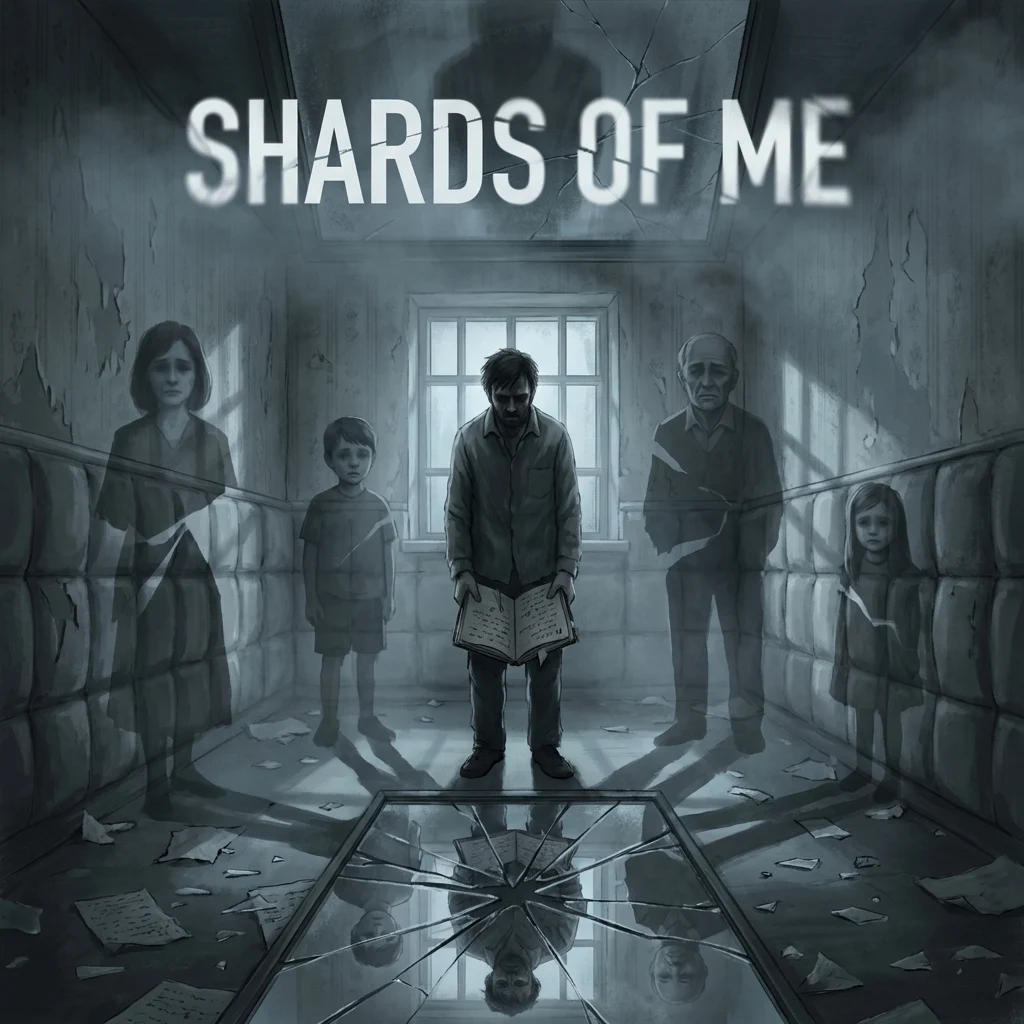
The mirror in the hallway was old, its silver backing flecked with age spots that made the reflection look diseased. Every morning, Thomas stared into it, searching for the man he used to be. His face was lined now, eyes sunken like pits in dough, hair thinning to wisps that clung desperately to his scalp. He was forty-seven, or so the driver’s license in his wallet said, but some days he felt like a boy again, hiding from his father’s belt.
‘Thomas,’ he whispered to the glass, ‘you’re still here.’ The reflection mouthed the words back, but its lips curled in a way that wasn’t quite right, a smirk that Thomas hadn’t intended. He blinked hard, and it was gone.
The apartment was a tomb of muted grays and browns, furniture sagging under the weight of neglect. He shuffled to the kitchen, where the coffee pot gurgled like a dying animal. As he poured the bitter brew, fragments of memory surfaced: laughter in a sunlit park, a woman’s hand in his, the sharp crack of a bottle breaking against the wall. Was that his wife? No, he’d never married. Or had he? The thoughts slithered away before he could grasp them.
Work was a fog. He was an accountant—or accountant-adjacent, crunching numbers for a small firm downtown. The office smelled of stale cigarettes and desperation, colleagues nodding politely but never quite meeting his eyes. ‘Morning, Tom,’ said Karen from accounting, her smile tight. ‘You look… rested.’
He nodded, settling into his cubicle. The screen glowed with spreadsheets, endless rows of figures that danced mockingly. Midway through reconciling a ledger, a sharp pain lanced his temple. The room tilted. Suddenly, he was nine years old, crouched under the school desk while bullies chanted his name—no, not his name. Timmy. Timmy the crybaby.
‘Thomas!’ Karen’s voice snapped him back. She hovered over his desk, concern etching her face. ‘You okay? You zoned out again.’
‘Fine,’ he muttered, rubbing his eyes. ‘Just a headache.’ But as she walked away, he saw it: the way she glanced back, pity in her gaze. Or was it fear?
Lunch was a sandwich from the deli, eaten alone on a bench in the park. Children played nearby, their shrieks piercing the air. One girl, pigtails bouncing, ran straight into his path, tumbling at his feet. She looked up, eyes wide and blue.
‘Sorry, mister!’ she chirped, scrambling up.
He smiled, but inside something twisted. ‘No harm done, kiddo.’ As she ran off, the pain returned, fiercer. Flash: him as a father, scooping that same girl into his arms. His daughter. Lily. But she was gone, taken by illness two years ago. No—the memory shifted. No daughter. No Lily. Just emptiness.
The rest of the day blurred. Home by six, TV droning news of some distant war. Dinner was microwave slop. Then bed, where dreams waited like predators.
In the dream, he was running through woods, branches whipping his face. Behind him, footsteps—his own? No, heavier. A voice called, ‘Thomas! Wait!’ But when he turned, it was his face staring back, younger, unlined, laughing maniacally.
He woke sweating, heart hammering. The clock read 3:17 AM. Thirst drove him to the kitchen, where he paused at the junk drawer. On impulse, he pulled it open. Amid receipts and rubber bands lay a photo, creased and faded: a young man with his arm around a woman, both grinning. Thomas picked it up, stomach churning. That was him, wasn’t it? But the woman… she looked like Karen. No, impossible.
Days bled into weeks. The fractures grew. At work, numbers refused to balance, always off by the same amount: 47. His age? Conversations with colleagues felt scripted, their words echoing strangely. ‘How’s the family, Tom?’ Mark from sales asked one day.
‘No family,’ Thomas replied automatically. But doubt gnawed. Hadn’t there been a wife? Arguments, slammed doors, a divorce papers signed in haste?
Nights brought more dreams. Now, the doppelganger spoke: ‘You’re not who you think. Peel back the layers.’
One evening, unable to sleep, Thomas dug deeper. Closet yielded a box: old letters, yellowed. ‘Dearest Timothy,’ one began. ‘I miss you more than words…’ Signed, Mom. Timothy? His hands shook. License said Thomas. Birth certificate tucked in the box confirmed: Timothy James Harlan, born 1977.
Panic clawed his throat. He rushed to the bathroom mirror. ‘Who are you?’ The reflection whispered back, lips not moving in sync. ‘Both. Neither.’
The next day, he confronted Karen. ‘Who am I really?’
She paled. ‘Tom, you’re scaring me. You’re Thomas Reed, our accountant. Been here ten years.’
‘Liar!’ He slammed his fist on the desk. Security escorted him out.
Home, he tore the place apart. Under the floorboards in the bedroom—how he knew to look there, he couldn’t say—a journal. Pages filled with his handwriting? No, neater, feminine. ‘Today Thomas smiled at me. He’s perfect. But Timothy watches from the shadows. I can’t let him out.’
His vision swam. Memories flooded: a car crash, blood on the windshield. He’d been driving, wife beside him—Karen? No, her name was Sarah. They’d fought. He swerved. She died. But he survived, assumed a new identity to escape guilt. Thomas Reed, bland accountant. But the old self, Timothy, simmered beneath.
Or was it the reverse? The journal continued: ‘I am Sarah. Thomas killed me, but I became him to survive. Timothy was the drunk driver who hit us. Now I wear his skin.’
Head spinning, Thomas—no, Timothy?—stumbled to the mirror. The face shattered inward, shards embedding in his palms as he punched it. Blood dripped, mixing with tears.
A knock at the door. Police? No, a woman. Karen—no, Sarah. ‘Tom? Open up. It’s me.’
He backed away. ‘Stay back! You’re dead!’
The door burst open. Not police, but men in white coats. ‘Mr. Harlan, time for your medication.’
They grabbed him. Strapped him to a gurney. As they wheeled him out, he saw the truth: the apartment was a set, cameras in corners. No, the hospital room materialized.
‘Thirty years,’ the doctor said, shining a light in his eyes. ‘You’ve been cycling through identities since the crash. Timothy died that night, but your mind splintered to cope. Thomas was just the latest mask.’
No—the final revelation hit as they sedated him. In the crash, there was no wife, no Sarah, no Thomas. Just Timothy, driving drunk, killing his own family—parents and little sister. The identities were them, woven into his fractured psyche to punish himself eternally. Each ‘self’ a fragment of the dead, haunting from within.
As darkness claimed him, the mirror voices harmonized in laughter. He was all of them, and none. Shards of me, forever breaking.