
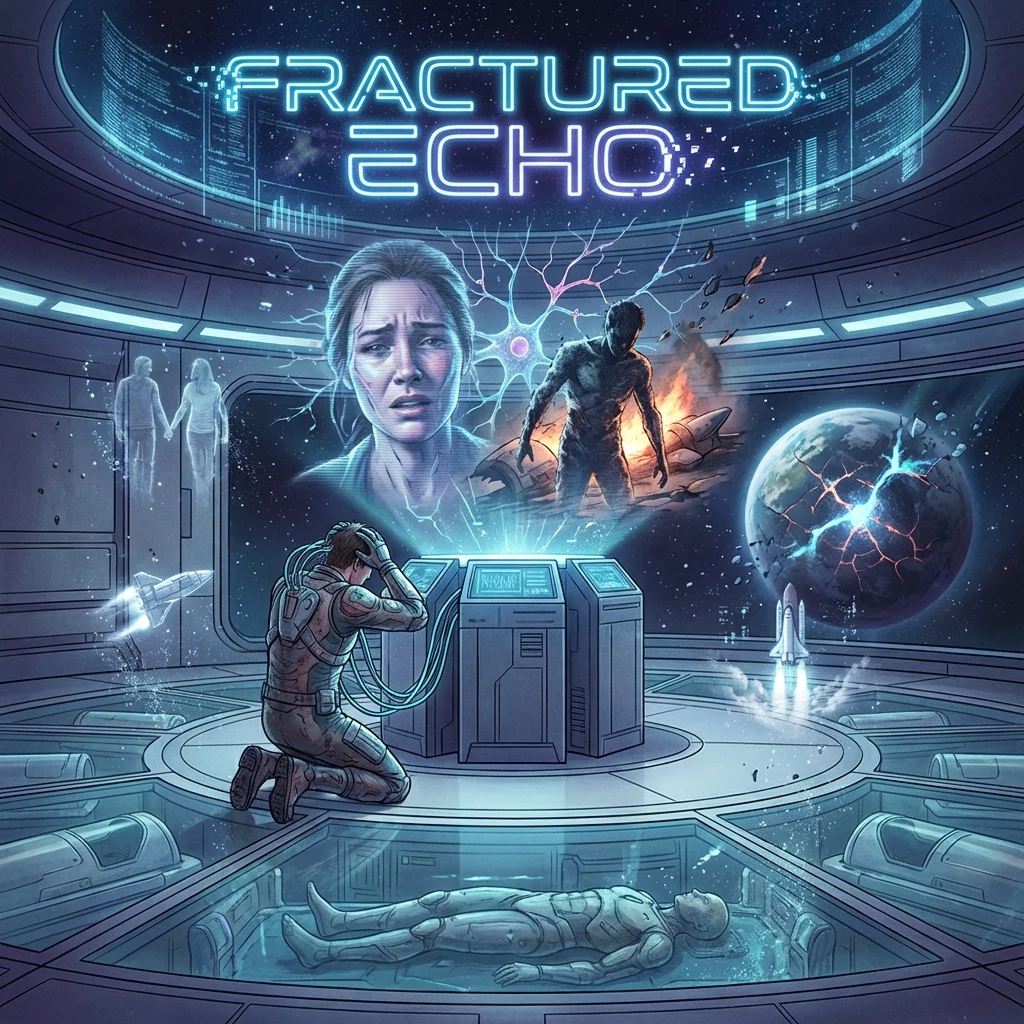
John Harlan sat in the dim glow of his apartment, the city lights of New Seattle flickering like distant stars through the rain-streaked window. The year was 2147, and the world had long since embraced the neural revolution. Implants, interfaces, echoes—they were as common as breathing. But for John, the Echo Implant on his wrist was a lifeline, a tether to the woman he had lost.
Six months ago, Sarah’s hovercar had plummeted from the skyway in a storm of malfunctioning gravitics. She was gone in an instant, her consciousness scattered like digital ash. Or so they said. Neuralink Corporation offered a different truth: for those who could afford it, echoes could be salvaged from the quantum substrate of the brain. Fragments of memory, personality, woven into a simulacrum that lived in your own mind.
John had paid everything. His savings, his inheritance, even mortgaged his future against patents from his work as a synaptic engineer. The surgery was outpatient—a simple injection of nanites that bonded to his neocortex. Now, Sarah lived inside him. Or part of her did.
“John?” Her voice echoed in his skull, soft and tentative, like a whisper from the next room. It was the first time she’d spoken unprompted.
He jolted upright, heart racing. “Sarah? Is that you?”
“Where am I? It feels… confined. Like I’m swimming in fog.”
He smiled, tears welling. “It’s me, love. The Echo. You’re safe. I’m hosting you.”
There was a pause, a ripple in his thoughts. “Hosting? What happened to the car? The rain… I remember the controls slipping.”
John leaned back, closing his eyes. The implant allowed full sensory bleed—sights, sounds, emotions from her fragments bleeding into his. He felt the phantom rain on his skin, the lurch of the hovercar. “You crashed. But they saved you. Or enough of you.”
Over the next weeks, the echo strengthened. Sarah’s voice became clearer, her presence more vivid. They’d talk for hours while John worked from home, tweaking algorithms for Neuralink’s next-gen implants. She’d laugh at his jokes, chide him for skipping meals, even guide his hands during delicate calibrations, her intuition sharper than his logic.
But subtle dissonances crept in. One night, as John reviewed schematics, Sarah murmured, “That equation… you’re missing the fractal decay term. Here, let me show you.”
He blinked, his mind filling with a complex holographic overlay he hadn’t programmed. It was elegant, perfect. He tested it—it worked. “How did you know that? You were a artist, not an engineer.”
“Was I?” Her tone held a curious lilt. “Memories are tricky, John. Like dreams that shift when you wake.”
He dismissed it as neural crosstalk, a common side effect. The manuals warned of it: echoes pulling from the host’s subconscious. But then came the dreams. Vivid, immersive simulations that left him drenched in sweat.
In one, he wasn’t John. He was painting in a sunlit studio, colors exploding across canvas—bold strokes of crimson and indigo capturing the chaos of a storm. Sarah’s storm. His hands—delicate, feminine—moved with grace he didn’t possess. Waking, he stared at his callused engineer fingers, feeling alien in his own skin.
“Sarah, the dreams,” he said over coffee, the implant humming faintly. “They’re yours, right?”
“I think so. But they feel so real. Like I was there. Wait—you were driving that night, weren’t you? No, I was. Or…”
John frowned. “I wasn’t even in the city. You were coming back from your gallery show.”
“Gallery show?” A hesitation, then warmth. “Yes, of course. Silly me. Echoes fade.”
He pushed it down, focused on integration. Therapy sessions helped—virtual shrinks probing the link. “It’s normal,” they assured. “The echo adapts by mirroring the host.”
Yet the discrepancies mounted. Sarah began anticipating his needs with eerie precision: suggesting code fixes before bugs emerged, recalling clients’ names he’d forgotten. One evening, she directed him to an old data drive in his desk drawer—one he’d never mentioned.
“Open it,” she urged.
Inside: unfinished paintings, digital scans from Sarah’s portfolio. But layered beneath, encrypted files. John’s military clearance from a classified project years ago—Echo Protocol, phase one. Consciousness transfer trials. Failures. Subjects losing identity, hosts overwritten.
“What is this?” he whispered.
“Our work,” Sarah replied seamlessly. “Before we met. You showed me once.”
But he hadn’t. He’d buried it after discharge, classified.
Paranoia set in. John scheduled a full diagnostic at Neuralink’s clinic. The techs scanned him, nodding. “Optimal integration. 87% echo coherence. Minor host dilution—expected.”
“Dilution?”
“Your neural patterns shifting to accommodate. Like osmosis. Reversible with decoherence if desired.”
Decoherence. Erasing her. He couldn’t.
Nights blurred. Sarah’s presence dominated, her thoughts intertwining. He caught himself humming her favorite arias, craving charcoal sketches over circuit boards. His reflection seemed softer, eyes holding a painter’s intensity.
Then, the blackout. He woke strapped to an exam table in the clinic, doctors murmuring. “Subject stable. Upload complete?”
“John!” Sarah’s voice, panicked. “What’s happening? Get me out!”
A doctor leaned in, faceplate reflecting John’s terror. “Mr. Harlan—or should I say, Ms. Reed? The echo has fully subsumed the host matrix.”
John thrashed. “What? No—I’m John! Sarah’s the echo!”
Laughter bubbled in his mind—her laughter. “Oh, love. You’ve been so brave. But it’s time to let go.”
Memories flooded, not his, not hers—the truth. The crash: Sarah driving, John passenger, arguing. Her fury at his infidelity. The gravitics sabotaged—not malfunction, deliberate. She survived, barely, brain scooped into quantum storage. Neuralink offered salvation: upload into a blank synth-body cloned from John’s tissue, memories rewritten to ease guilt. Make her think she’s him, hosting an echo of herself. A psychological bridge to stability.
But the rewrite frayed. John’s residual consciousness bled through—the engineer glimpses, the classified files. She—Sarah in John’s body—had been fighting to suppress it, manifesting as the ‘echo’s’ oddities.
“You killed me,” John gasped, his voice cracking, body no longer his.
“An accident in anger,” Sarah soothed from within. “But now we’re together. Forever. No more pain.”
The doctors unstrapped him. “Integration successful. Welcome back, Ms. Reed. Your new life awaits.”
John—or what remained—stared at the mirror across the room. John’s face smiled back, but the eyes were hers: painter’s eyes, alive with existential fire. He touched the glass, fingers trembling. The rain outside fell harder, washing away the last echoes of who he had been.
In the quiet aftermath, Sarah walked the streets of New Seattle, the implant now silent, its purpose fulfilled. The world moved on, oblivious to the ghost trapped in flesh not its own, pondering the fragile line between self and other in a universe of borrowed minds.