
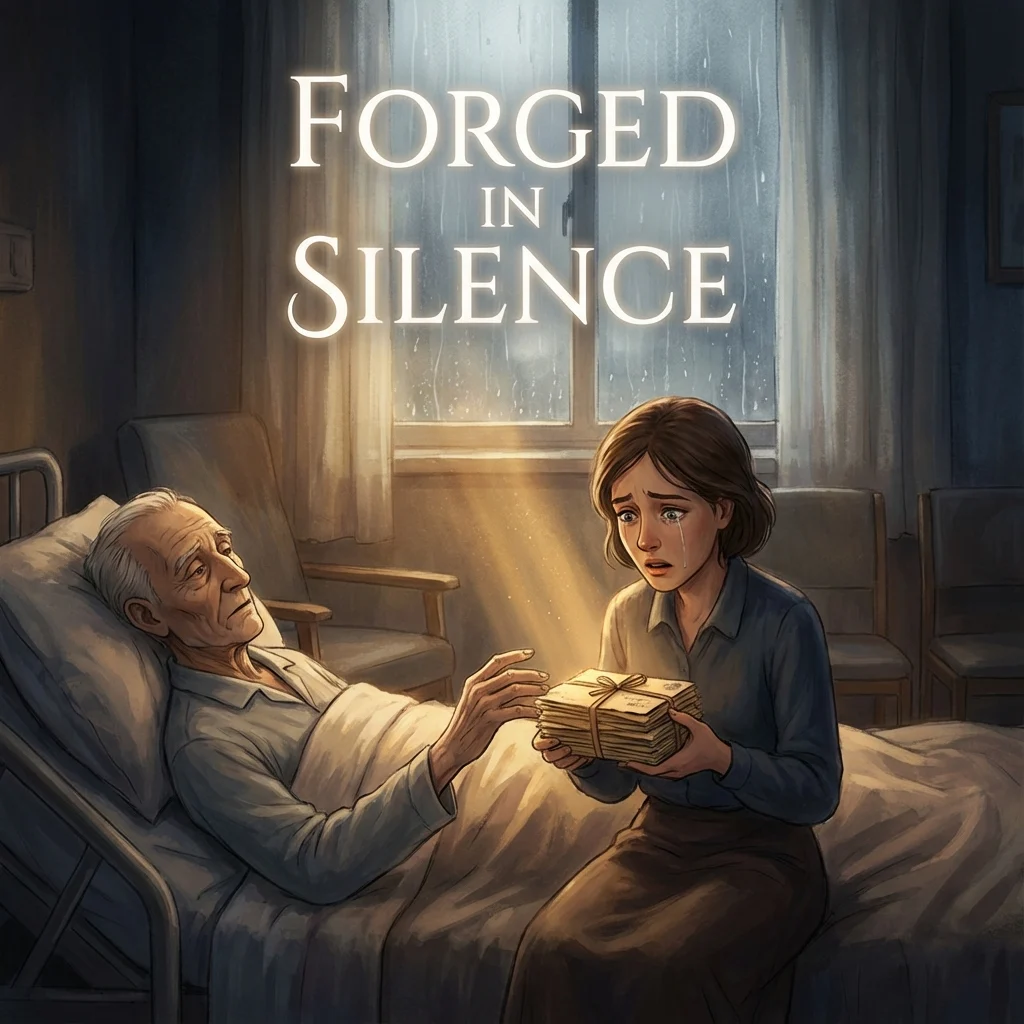
The rain drummed softly against the warped roof of the old Victorian house, a relentless whisper that mirrored the ache in Anna’s chest. She hadn’t crossed this threshold in twenty-two years, not since the night she packed a single bag and left her father behind, convinced he was the architect of all her misery. Now, at forty-two, with lines etched deep around her eyes from years of nursing unspoken grudges, she returned because a social worker’s call had been blunt: Harold Jenkins had days, maybe hours.
The house smelled of mildew and regret, the air thick with dust motes dancing in the slivers of gray light filtering through heavy curtains. Anna set her overnight bag down in the foyer, her boots leaving wet prints on the faded runner. From the end of the hall came a faint cough, rasping like dry leaves. She straightened her coat, smoothed her hair, and walked toward it.
Her father lay propped up in a hospital bed in what used to be the living room, surrounded by medical equipment that beeped sporadically. His once-robust frame had withered to bones draped in parchment skin, his eyes sunken but sharp. Tubes snaked from his arms to hanging bags of fluid. He turned his head as she entered, and for a moment, neither spoke.
“Anna,” he whispered, voice like gravel. “You came.”
She nodded, throat tight. “I had to.”
He gestured weakly to a chair beside the bed. She sat, hands folded in her lap, staring at the blanket covering his legs. The silence stretched, heavy with the weight of decades.
“How long?” she finally asked.
“Not long. Liver. Years of… well, you know.” He trailed off, eyes flicking to the floor.
She did know. Whiskey had been his companion after Mom died. After the suicide that shattered their world when Anna was twelve. Harold had withdrawn into himself, leaving her to fend for emotions she couldn’t name. School counselors, teachers—they all said it was grief. But Anna had seen it as abandonment. She’d screamed it at him the night she left: ‘You killed her! Your drinking, your neglect!’ And he’d just stood there, silent, as she slammed the door.
“I’ve been cleaning out the attic,” the social worker had said on the phone. “Found some letters. From your mother. Thought you should have them.”
Anna had taken them without reading, stuffing them into her purse like contraband. Now, she pulled them out, a bundle tied with frayed twine. “These. Did you know about them?”
Harold’s eyes widened fractionally. “Where…”
“Attic. She wrote them to you before… before she did it. Blaming you. For everything.” Anna’s voice cracked. “Why didn’t you ever show me? Fight back?”
He closed his eyes, breath shallow. “Didn’t matter then. Doesn’t now.”
But it did matter. To Anna, it had defined her life. Marriages that failed because she expected men to fail her. A career in social work, ironically, pouring into other broken families what she’d never had. Therapy sessions where she’d dissected his flaws like a surgeon, never once considering her own scalpel-sharp rage.
That night, as rain lashed the windows, Anna untied the twine and began reading aloud. The letters were raw, penned in her mother’s looping script.
*Harold, how can you come home smelling of booze every night? The girl cries for you, and you’re lost in a bottle. If you don’t change, I can’t stay in this tomb of a house.*
*Another fight. You push me away, and I shatter. Anna sees it all. What kind of father lets his daughter witness this poison?*
*The end is near for me. You’ve killed whatever love was left. Live with that.*
Each word landed like a stone in Anna’s gut. She looked up, tears blurring her vision. “She hated you. And you let her die alone.”
Harold’s hand trembled as he reached for hers. She pulled away. “Let me explain…”
“Explain what? You drove her to it!” Anna stood, pacing the room. Memories flooded: Mom’s tired smiles, the way she’d hug Anna tight before bed, whispering, ‘Be strong for both of us.’ The discovery of her body in the garage, exhaust from the car filling the space. Harold finding her, calling the cops, then retreating into silence.
Days blurred into a vigil. Anna cooked meager meals from canned goods, changed his dressings, administered meds under hospice instructions. Between beeps and drips, they talked—haltingly at first. He spoke of his youth, factory work, how the layoffs crushed him. “I tried to provide. But the bottle… it whispered louder.”
Anna softened, seeing the man beneath the myth. One evening, as thunder rumbled, she sat holding his hand. “Why didn’t you fight for her? For us?”
“I did, in my way.” His voice was fainter now, breath labored.
She brought out the letters again, reading the harshest one: *You’ve destroyed us, Harold. Anna will grow up despising you, as she should.*
He winced. “Put them away, Anna. Please.”
“No. Face it.”
The next morning, the hospice nurse increased the morphine. Harold slipped in and out of sleep, murmuring Mom’s name. Anna stayed by his side, the letters on the bedside table like accusing ghosts. Regret gnawed at her—not just for him, but for her own hardness. Had she been fair? Could forgiveness come this late?
By afternoon, he rallied slightly, eyes clearing. “Anna… come closer.”
She leaned in, heart pounding.
“Those letters…” He coughed, wincing. “I knew.”
“Knew what?”
“They’re not hers. Handwriting… off. Yours, Anna. When you were twelve. You found her diary, mimicked it. Left them in my drawer to punish me. After she… after the garage.”
The world tilted. Anna recoiled, mouth agape. “No… I… that was a game. I hid them.”
“Found them. Read them. Knew it was you—ink smudges, childish loops in the ‘a’s. But I kept them. Let you believe… let you hate me. Easier than you hating yourself.”
“But Mom’s words… they were true! You drank, you neglected—”
“Some true. But those letters fueled your fire. I carried the guilt—for her death, my failures. But also for you. Wanted you to have a villain, not… mirror.”
Tears streamed down Anna’s face, hot and unrelenting. The accusations she’d hurled for decades—echoes of her own forged venom. The distance he’d maintained? Protection. His silence? Sacrifice. Every argument, every therapy rant, built on a lie she’d crafted in grief-stricken rage.
“Why now?” she whispered.
“Time for truth. Forgive yourself, girl. I always did.” His eyes fluttered shut, hand going limp in hers.
The monitors wailed. Anna held him as life ebbed, the rain outside softening to a hush. In that room, amid the ruins of fabrication and forgiveness, she confronted the real ghost: her twelve-year-old self, wielding words like weapons. The guilt that had haunted Harold now settled in her, but lighter, laced with release.
She gathered the letters, burned them in the sink that night, watching flames devour the past. Dawn broke clear, and Anna walked out changed—not absolved, but unburdened. The house stood empty behind her, secrets finally laid to rest.