
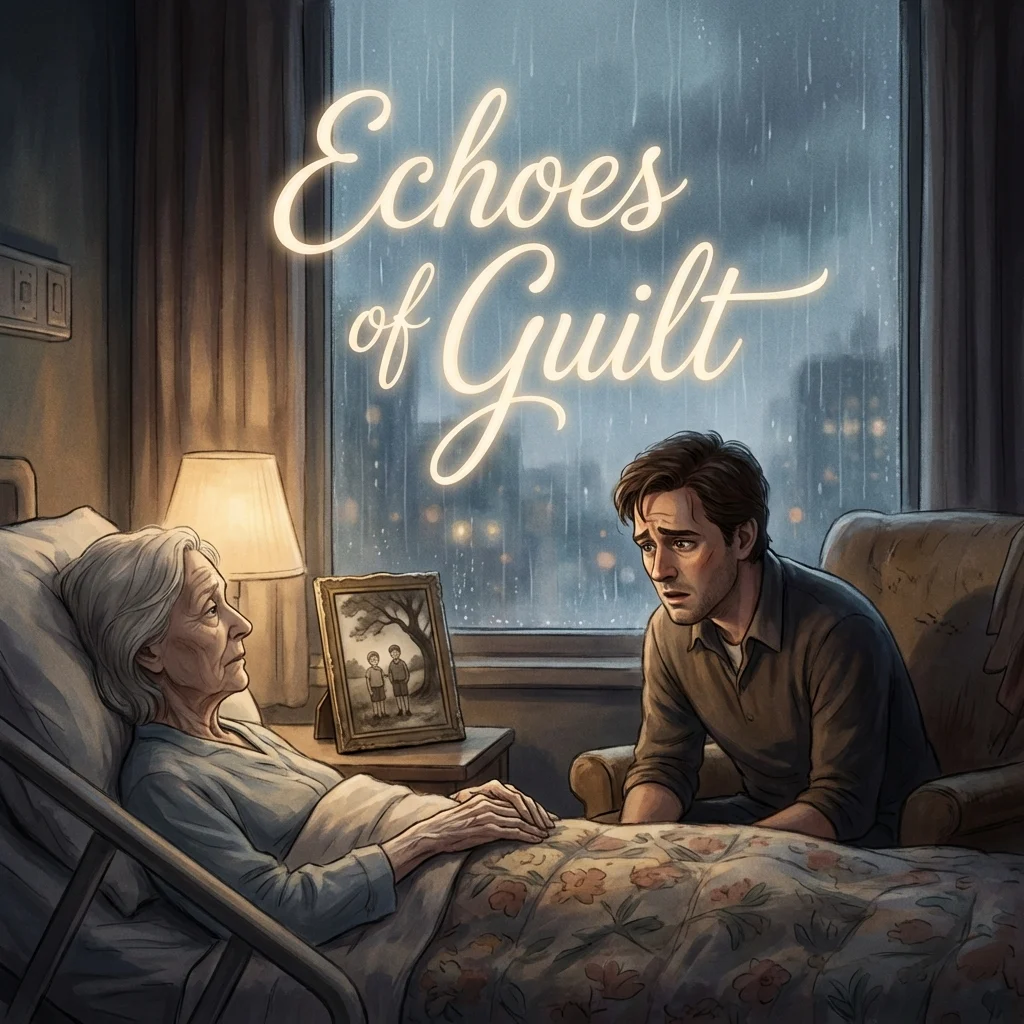
Jack stood at the edge of the overgrown yard, the old Victorian house looming before him like a specter from a half-forgotten dream. The paint peeled in long, sorrowful strips, and the windows stared back with empty, judgmental eyes. It had been thirty years since he last crossed this threshold, thirty years since the accident that shattered his family and exiled him from its remnants. Now, at fifty-two, with silver threading his dark hair and lines etched deep into his face from a life of quiet self-flagellation, he had returned. His mother’s letter had arrived like a summons from the grave—frail handwriting pleading for him to come home before it was too late.
The front door creaked open before he could knock, revealing his mother, Evelyn, shrunken and fragile in her wheelchair. Her once-vibrant blue eyes were clouded with age and illness, but they sharpened when they landed on him. “Jack,” she whispered, her voice a rasp of wind through dry leaves. “You came.”
He knelt beside her, taking her paper-thin hand in his. “Of course, Ma. I wouldn’t leave you like this.” The words tasted bitter, laced with the regret that had become his constant companion. He had built a life in the city—successful architect, married briefly, divorced amicably, no children to carry his burdens. But success was hollow when every blueprint he drew echoed the twisted limbs of the oak tree where his brother had fallen.
Tommy. Eight years old, all freckles and fearless grins. Jack, ten, the big brother who was supposed to protect him. That summer day, the air thick with heat and the buzz of cicadas, Jack had dared Tommy to climb higher. “Come on, scaredy-cat! Bet you can’t reach the top branch!” The words replayed in Jack’s mind nightly, a loop of torment. Tommy had scrambled up, laughing, until a branch snapped, and he plummeted twenty feet to the unyielding ground. Neck broken, gone in an instant.
Evelyn never forgave him. Not overtly—she never screamed or struck him—but her silence was a blade. She packed his bags a week after the funeral, sent him to live with an aunt in the city. “You need to learn responsibility,” she’d said, her voice flat as grave dirt. Jack understood. He had killed his brother with a careless dare. He carried that guilt like a stone in his chest, letting it shape him into a man who played it safe, who avoided risks, who never climbed too high.
Inside, the house smelled of dust and lavender soap, Evelyn’s scent. She wheeled herself to the living room, where faded photographs lined the mantel: Dad, stern and distant, gone five years before Tommy; Tommy, beaming in his Little League uniform; Jack, awkward pre-teen, already shadowed by sorrow. “Sit,” Evelyn commanded softly. Jack obeyed, perching on the edge of the sagging sofa.
“You look tired,” she said, studying him. “What have you been doing with yourself?”
He shrugged, reciting the sanitized version: career, travels, a few friendships. He omitted the therapy sessions, the failed engagements, the nights staring at ceilings wondering if Tommy watched him with accusation. “And you?” he asked, though he knew. Cancer, stage four, months if lucky.
“I’ve been waiting,” she replied cryptically. “For this. For you.”
The days blurred into a rhythm of caregiving. Jack cooked simple meals—oatmeal, soup—helped her to bed, read from her worn Bible. In the quiet hours, memories surfaced unbidden. He remembered Tommy’s obsession with that oak, how he’d beg to climb it daily. Jack had always joined him at first, but that day… pride had swelled in his chest. He wanted to prove he was braver. “Higher, Tommy! Show me you’re not chicken!” The crack of wood, the scream cut short, the thud. Jack running, screaming for Dad, who wasn’t home. Evelyn arriving, her face crumpling as she cradled Tommy’s lifeless body.
One evening, as rain pattered against the panes, Evelyn grew lucid, her eyes clearing. “Tell me about your life, Jack. Really.”
He hesitated, then poured it out—the guilt that choked him, how he’d dedicated his career to building safe structures, bridges that wouldn’t fail like that branch. “I killed him, Ma. I know it. Every day, I wish I could take it back.”
She nodded slowly, tears tracing rivulets down her cheeks. “Guilt is a heavy chain, son. It’s chained you longer than you know.”
He wiped her face with a handkerchief, his throat tight. “Forgive me? Before… before it’s too late?”
Her hand trembled in his. “There’s more to forgive than you think.”
Nights were hardest. Jack wandered the house, flashlight in hand, avoiding the backyard where the oak still stood, scarred but sentinel. In Tommy’s old room, posters of astronauts peeled from walls, a model rocket half-assembled on the shelf. Jack sat on the bed, holding Tommy’s baseball glove, inhaling the faint leather scent. “I’m sorry, little brother,” he whispered to the shadows. “I should’ve been better.”
A week passed. Evelyn weakened, her meals refused. Jack called the hospice nurse, who came daily, murmuring about comfort care. His sister, Laura, arrived from across state—distant, polite, but her eyes held the same wariness as Evelyn’s. They hadn’t spoken much since childhood; she’d stayed with Ma, become a teacher, married, two kids. “Good to see you stepping up,” she said coolly over coffee.
“I owe it to her,” Jack replied. “To all of you.”
Laura’s lips thinned. “Some debts are never paid.”
Tension simmered. Jack felt it in stolen glances, in Laura’s reluctance to leave Ma alone with him. He understood. He was the black sheep, the daredevil who destroyed.
One afternoon, Evelyn rallied, demanding to go outside. Jack wheeled her to the garden, the oak looming. She stared at it, transfixed. “Do you remember that day, Jack? Every detail?”
“Like it was yesterday,” he choked.
“Tell me.”
He did, voice breaking: the dare, the climb, the fall.
Evelyn’s face hardened. “Is that what you think happened?”
His heart stuttered. “What… what do you mean?”
She gripped his arm with surprising strength. “Tommy didn’t climb because of your dare, Jack. He dared *you*. He was the wild one, always pushing. ‘Come on, Jack! Bet you can’t touch the sky branch! Be brave like me!’ You said no. You were scared, smart enough to know better. But Tommy… he couldn’t stand down. He went up alone to prove it.”
Jack recoiled, world tilting. “No. That’s not… I remember—”
“You remember what I let you believe,” Evelyn cut in, voice steel beneath frailty. “After the funeral, you were broken, blaming yourself. I saw it eating you. I told you it was your dare, your fault. I needed you to toughen up, to not be like your father, weak and lost. Guilt made a man of you. It chained you, but it saved you.”
Laura appeared then, eyes wide. “Ma, no—”
“Truth now,” Evelyn gasped. “Forgive me, Jack. I made your guilt my weapon.”
The revelation crashed like the branch that never snapped in his true memory. All those years—therapy, isolation, safe choices—built on a lie Evelyn forged. Not to punish, but to forge him. Tommy’s death was accident, not fratricide. Jack’s chest heaved, sobs wracking him. Rage, relief, grief anew.
Evelyn’s breath rattled. “Live free now, son.” Her eyes closed, hand slackening.
Laura knelt beside him, tears flowing. “She told me years ago. I wanted to tell you, but…”
Jack stared at the oak, seeing it anew—not tombstone, but testament to a boy’s bravado. His chains shattered, but scars remained. He buried his mother beside Tommy, sold the house, returned to the city not as penitent, but as man unchained. Yet in quiet moments, melancholy lingered, reflective on a life reshaped by a mother’s cruel mercy.