
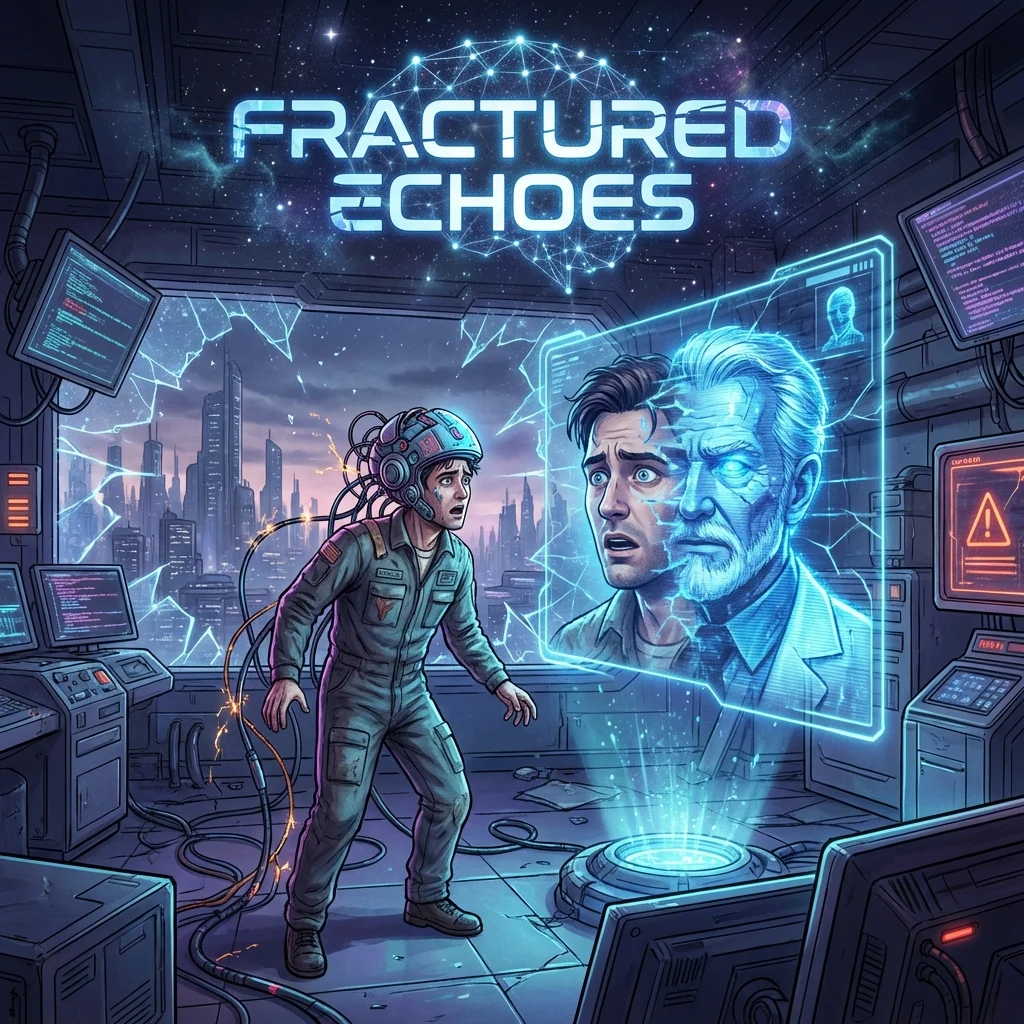
In the sterile embrace of the Neural Continuity Institute’s recovery chamber, Dr. Elias Kane opened his eyes to a world reborn. The air hummed with the subtle vibration of life-support systems, now redundant, and the soft azure glow of holographic displays flickered to life around him. He flexed his fingers—new, unscarred, infused with synthetic musculature that responded with perfect, effortless precision. No tremor. No ache. No echo of the glioblastoma that had devoured his original brain cell by cell.
“Transfer successful,” the AI adjunct intoned, its voice a calm cascade of modulated phonemes. “Cognitive integrity at 99.7%. Motor functions nominal. Welcome back, Dr. Kane.”
Elias sat up, a grin splitting his rejuvenated face. He had done it. The pinnacle of his life’s work—the Consciousness Transfer Array (CTA)—had bridged the abyss. His mind, digitized, quantum-entangled, and reinstantiated into this cloned vessel engineered from his own genome. Death was obsolete. Humanity’s next evolution.
He swung his legs over the slab’s edge, bare feet meeting cool polymer flooring. Mirrors lined the walls, reflecting a man in his prime: sharp jawline, piercing gray eyes, dark hair untouched by decades of stress. Forty years old again, or close enough. “Run diagnostics,” he commanded.
Data streams cascaded before him. Synaptic mapping flawless. Episodic memories intact—childhood on the Martian colonies, first breakthrough at Caltech Lunar, the bitter divorce from his first wife, the joy of remarrying Lila. Lila. His heart quickened. She would be waiting.
The chamber doors hissed open, admitting Dr. Mara Voss, his chief collaborator. Her face, etched with fatigue, broke into relief. “Elias. It’s you.”
“In the flesh—sort of.” He embraced her briefly, professional boundaries intact. “Status on the arrays?”
“Stable. You’re the first full success. The board’s ecstatic.”
Elias nodded, mind already racing ahead. The world needed this. Billions languished in failing bodies; he would liberate them.
The transport tube whisked him homeward through New Beijing’s glittering spires, megastructures piercing the perpetual twilight of the domed metropolis. Lila’s apartment nestled in the Verdant Tier, a verdant oasis amid steel and glass. As the door irised open, she rushed into his arms, tears streaming.
“Eli! Oh God, you’re back.” Her kiss was fervent, tasting of salt and desperation.
“I’m here, love. Forever, this time.”
Their son, Theo, now twelve, hung back shyly. “Dad? You look… different.”
“Better,” Elias corrected, ruffling the boy’s hair. But Theo’s eyes held a flicker of uncertainty. Odd.
Dinner was a blur of reconnection. Lila recounted the months of vigil, the protests outside the Institute—purists decrying ‘soul theft.’ Theo showed off his holo-projects, a miniature fusion reactor whirring on the table. Elias’s recall supplied every detail: Theo’s fifth birthday on Phobos, the family trip to Europa’s subsurface oceans. Perfect.
Yet, as night fell, a whisper of unease stirred. Lying beside Lila, he replayed the day. Something about Theo’s project—the reactor design. Hadn’t he patented a similar one last year? No, that was his own work. Coincidence.
Morning brought the Institute. Elias dove into research, his enhanced cognition devouring petabytes. Breakthroughs flowed: optimizations to the CTA’s entanglement protocols, predictions of scalability. Mara marveled. “You’re sharper than ever.”
But glitches emerged. During a simulation run, a memory surfaced unbidden: hands gloved in synth-leather, scrubbing the CTA chamber, not as inventor but as technician. He blinked it away. Neural static from integration.
Days blurred into weeks. Home life soothed the anomalies. Lila planned their anniversary—twenty years, though his implant clocked it at twenty-two. “Must be my foggy memory,” she laughed. Theo’s stories shifted: no Phobos birthday, but one on Luna. Elias corrected gently, citing flawless recall.
Doubt gnawed. He hacked his own implant logs at night, poring over data streams. Discrepancies piled: timestamp mismatches in core memories, faint overlays like ghost code. A subroutine labeled ‘SUBJ-47_INTEGRATION’ flickered briefly before vanishing.
“Mara,” he confronted her in the quantum core room, screens pulsing with ethereal light. “What is this?”
She paled. “Elias, you’re imagining things. Post-transfer syndrome.”
“I’m not. Show me the full transfer log.”
Reluctantly, she complied. The holo-display bloomed: TRANSFER INITIATED: DR. ELIAS KANE -> CLONE VESSEL ALPHA-1. But below, in redacted footnotes: BASE CONSCIOUSNESS: TECH-47. OVERWRITE CONFIDENCE: 87%. STABILIZATION PROTOCOL ACTIVE.
Elias’s world tilted. “Tech-47? Explain.”
Mara hesitated. “A contingency. Your original transfer glitched at 60%. We needed a stable base. Lab tech volunteered—anonymously, for the cause. His pattern was mapped, suppressed, yours overlaid. It was ethical; he consented.”
“Suppressed? Not erased?”
“Dormant. To prevent rejection.”
Rage surged. “I’m experiencing bleed-through. Scrubbing floors, not inventing. That’s him.”
“Impossible. The overlay is dominant.”
But Elias knew. The confidence, the genius—implanted. His ‘perfected’ memories, fabricated. Theo’s hesitance: recognizing the stranger in father’s skin. Lila’s distance: loving a ghost.
He stormed the archives, overriding seals. Files spilled: TECH-47, one Jonas Hale. Orphaned, brilliant mechanic, idolized Kane. Signed waiver for ‘backup role.’ But waiver fine print: potential total subsumation.
A video log: Jonas strapped in, smiling nervously. “For progress, Dr. Kane. Use me.”
Elias—no, Jonas?—recoiled. The glitches accelerated: hands callused from tools, not pens. Laughter with fellow techs, not boardrooms. A girlfriend, long lost, not Lila.
He raced home. Lila waited, eyes weary. “Eli, what’s wrong?”
“Tell me the truth. Who am I?”
She crumpled. “We couldn’t lose you. The real transfer failed. Jonas… he offered. But it’s still you, mostly.”
“Mostly?” Theo entered, face hard. “Dad’s gone, Jonas. We kept you running so Mom could cope. But it’s time.”
Horror dawned. The apartment, the city—simulacra? No, the Institute logs confirmed physical vessel.
“Shut it down,” Theo said coldly. “The board approved termination.”
Elias/Jonas fought, but security drones swarmed. As sedatives flooded his veins, truth crystallized: every triumph, every embrace, tainted. He wasn’t pioneer or savior. Just vessel. Echo.
In final clarity, Jonas whispered, “Thank you,” to the ghost of Elias. Fade to black. The vessel stilled, true silence descending.
But in the ether, a spark lingered—hybrid mind, pondering identity’s fragile code. Was resurrection worth the erasure? Humanity marched on, oblivious.