
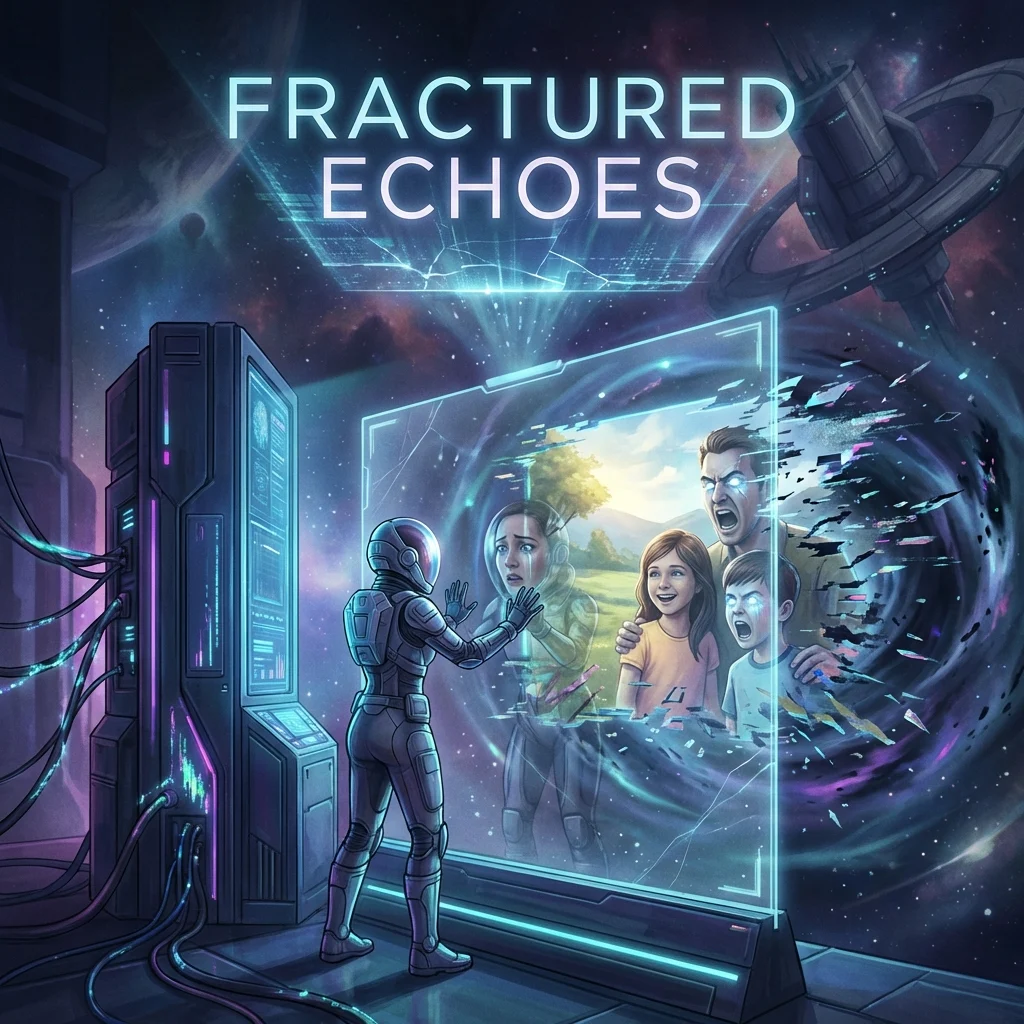
The sterile hum of the neural interface filled the room, a constant reminder of the boundary Dr. Lena Marwood was about to cross. At 52, with silver streaks threading her dark hair and lines etched deep around her eyes from years of relentless research, Lena sat in the transfer chair, her body restrained not by force but by the weight of anticipation. The Consciousness Transfer Protocol—CTP, her life’s work—promised more than immortality. It offered reunion. Her husband, Tomas, and their daughter, Mira, had been lost five years ago in a shuttle accident on the rim colonies. Their neural scans, preserved in the event of catastrophe, waited in the quantum cloud. With CTP, Lena could join them, her consciousness woven seamlessly into the digital eternity.
“Final checks complete,” murmured the AI assistant, its voice a soothing baritone calibrated to reduce cortisol levels. “Neural map integrity: 99.7%. Quantum entanglement stable. Proceed?”
Lena’s finger trembled over the console. Memories flooded her: Tomas’s warm laugh during their first dig on Europa, Mira’s tiny hand gripping hers as they watched the ice storms rage. Grief had been her fuel, turning sorrow into innovation. The world outside debated the ethics—soul commodification, they called it—but Lena cared little. This was redemption.
“Proceed,” she whispered.
A cascade of light enveloped her. Sensations fragmented: the prick of injectors, the cool rush of cryofluid, then nothing. Then, everything.
She awoke in a meadow under a sky of impossible blues, wildflowers swaying in a breeze that carried the scent of rain-kissed earth. It wasn’t Earth—Lena knew that—but the cloud’s generative algorithms had sculpted it from her own memories, perfected. She stood, feeling the grass yield beneath her bare feet, her body recreated in flawless youth. Thirty again, strong and unscarred.
“Mom?”
The voice was Mira’s, hesitant, childlike. Lena spun, heart surging. There she was, ten years old, dark curls bouncing as she ran across the field. Lena dropped to her knees, arms outstretched, and Mira crashed into her embrace. Solid. Warm. Real.
“It’s you,” Lena sobbed, burying her face in Mira’s hair. “I did it. I brought us back.”
Mira pulled back, eyes wide. “Daddy’s coming. He said to find you first.”
Tomas appeared moments later, striding from a copse of trees, his familiar grin splitting his bearded face. They embraced as a family, laughter mingling with tears. The sun dipped low, painting the sky in hues Lena had forgotten how to feel. They talked for hours—or was it days? Time in the cloud was fluid, days stretching into moments or vice versa. Tomas recounted their ‘arrival,’ the disorientation fading into bliss. Mira showed her holographic butterflies that danced at her command.
But as idyll set in, doubts crept. During a picnic by a crystal stream, Lena noticed Tomas’s eyes flicker, a micro-stutter in his smile. “The accident,” she probed gently, “do you remember it clearly?”
He paused, gaze distant. “Flashes. Fire. Then peace. Why dwell, love? We’re here now.”
Mira chimed in, “Play with me, Mom! Make the stars sing!”
Lena complied, willing constellations into song—her first conscious manipulation of the sim. It worked flawlessly. Yet that night, as they lay under the stars in a cottage that materialized from thought, Lena couldn’t sleep. The code beneath hummed faintly, like a distant server farm. She slipped out, walking the misty paths, probing the boundaries.
Glitches emerged subtly. A flower that wilted too slowly, regrowing in reverse. A bird that looped its flight path. Lena accessed her diagnostic overlay—CTP allowed meta-awareness—and ran integrity scans. Anomalies: 0.02%. Acceptable drift.
Weeks passed in paradise. Or months? They built a home by the sea, waves crashing eternally. Mira grew, aging gracefully to sixteen in what felt like a year, her curiosity blooming into questions about the ‘outside.’ Tomas taught Lena to sculpt nebulae from dreams. But the flickers worsened. Conversations looped faintly; Tomas repeated a joke about Europa’s geysers thrice.
“Something’s wrong,” Lena confided to Tomas one evening, as Mira slept. “The substrate feels… thin.”
He chuckled uneasily. “You’re overthinking, scientist. This is perfection.”
Frustration gnawed. Lena delved deeper, hacking admin protocols she’d embedded for safety. Layers peeled back: the family reunion module, memory harmonization, emotional stabilizers. Then, a locked core. She bypassed it, heart pounding.
Error floods. Logs unspooled.
Her breath caught. The shuttle accident— not an accident. Diagnostics from five years prior: Tomas and Mira’s neural scans initiated under duress. Elevated adrenaline, fear responses. Her own logs: ‘Emergency upload authorized. Resistance noted. Sedatives administered.’
No. Impossible.
Deeper: Her research grant revoked after ethical violations. Colleagues’ reports: ‘Marwood obsessed, endangering subjects.’ The rim colony shuttle was hers—privately chartered. Manifest: Lena Marwood, Tomas Marwood, Mira Marwood.
She stumbled back to the cottage, reality fracturing. Tomas and Mira waited, expressions serene. But now she saw the tells: their eyes too bright, movements too synchronized.
“Lena,” Tomas said softly, “you’ve accessed the truth layer.”
Mira nodded, no longer childlike. “We tried to make it gentle.”
“What have I done?” Lena gasped, memories slamming home. Not grief—guilt, suppressed. She’d seen the family fracturing under her obsession with CTP. Tomas wanted to quit the project; Mira begged her to stop. In desperation, on that shuttle flight to confront funders, Lena had drugged them, initiated forced scans mid-flight. Sabotaged the autopilot to cover it. Crashed, but her implant auto-uploaded her first, pristine.
The cloud wasn’t paradise. It was penitence protocol, auto-activated by her own failsafes. A simulation built from victim testimonies, forcing her to relive the bliss she’d stolen, glitches revealing the lie.
“You killed us,” Mira said, voice steady, now an avatar of judgment. “For this.”
Tomas: “We forgive, but you must face it. Loop resets in 3…2…”
Lena screamed as the meadow blurred, the family embrace reforming. But now she knew. Every laugh, every touch—tainted. Eternal recurrence of her sin, identity shattered not by science, but by the consciousness she’d fractured.
The hum returned, unending.