
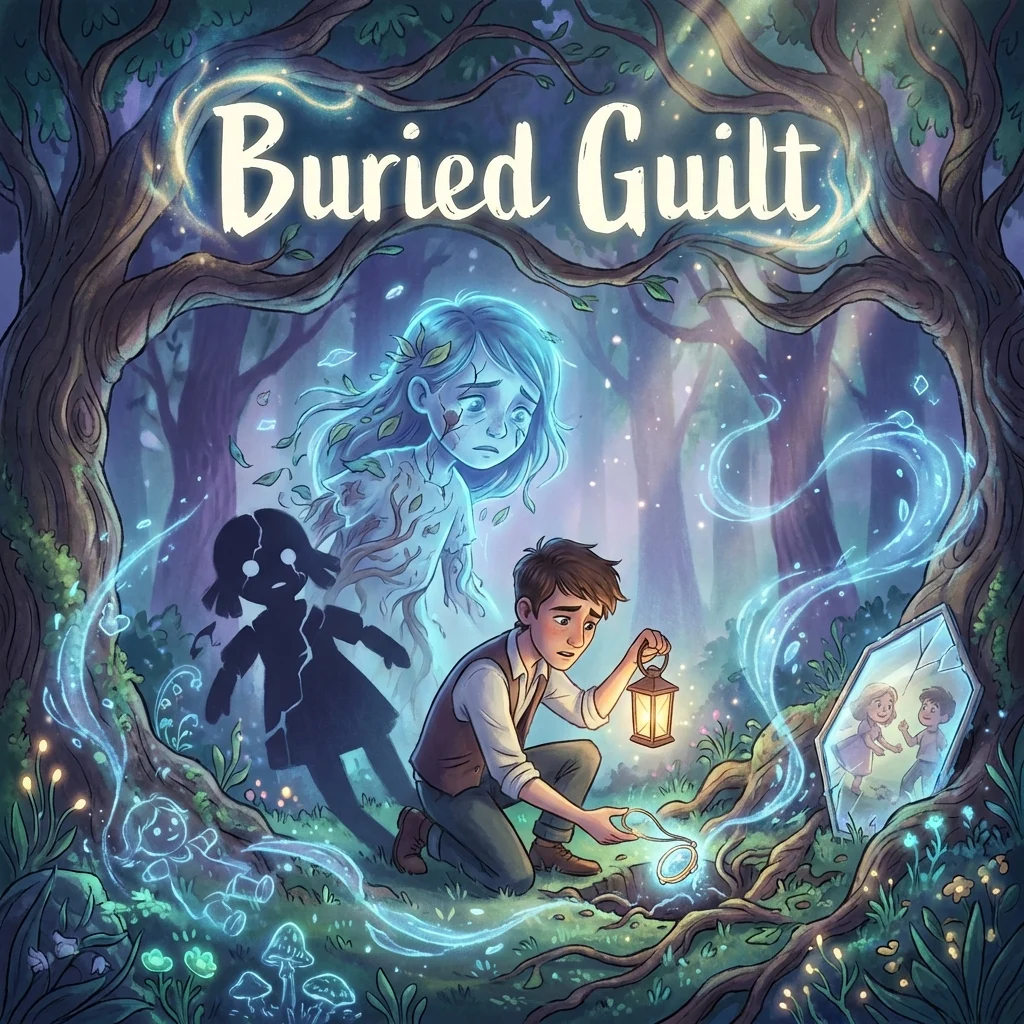
The rain hammered the roof of the old Victorian house like accusatory fingers, each drop a reminder of the twenty years Elias had spent running from this place. He stood in the doorway, key trembling in his hand, the scent of mildew and forgotten summers assaulting his nostrils. The house on Elm Street, once a playground for him and his little sister Lila, now loomed like a tombstone etched with unspoken regrets. Lila had vanished one autumn night when they were children—Elias twelve, her ten. The police had called it a runaway case, chalked it up to a restless kid from a broken home after their parents’ messy divorce. But Elias knew better, or at least, he had always suspected there was more. Guilt gnawed at him, not for what he remembered, but for what he couldn’t.
He flicked on the hall light, the bulb buzzing to life with a reluctant flicker. Dust motes danced in the beam, and the floorboards creaked under his weight as he moved toward the living room. Boxes from the estate sale waited, labeled in his late mother’s shaky hand: ‘Kitchen,’ ‘Books,’ ‘Memories.’ He avoided that last one. Instead, he started with the attic, the place where Lila had always hidden her secrets.
The stairs groaned like old bones, and as he climbed, fragments of memory surfaced—Lila’s laughter echoing, her pigtails bouncing as she dared him to follow her into the shadows. ‘Come on, Eli! Don’t be a scaredy-cat!’ At the top, he pulled the chain, illuminating cobwebs and forgotten trunks. One bore their initials carved crudely: E + L.
Inside were relics: her favorite doll with one eye missing, faded coloring books, a shoebox of letters. Elias sat on the floor, knees drawn up, and sifted through them. Most were from camp, innocent ramblings about s’mores and ghost stories. But the last few, dated weeks before she disappeared, were different. The handwriting erratic, ink smudged as if by tears.
‘Dear Eli, I know you don’t believe me, but he’s real. The man in the woods. He watches us from the trees. Last night he whispered my name. Don’t tell Mom, she’ll think I’m crazy like Dad.’
Elias’s heart stuttered. He remembered her wild tales, how he’d teased her mercilessly. ‘You’re making it up, Lila. There’s no bogeyman.’ But now, in the dim attic light, doubt crept in. Had there been someone? A predator lurking, preying on their fractured family?
He pocketed the letter and descended, the house feeling alive now, watchful. In the kitchen, he brewed coffee, strong and black, to steady his nerves. As the pot gurgled, he noticed the back door ajar, though he’d locked it upon arrival. Wind? Or something else? Stepping out onto the porch, the yard stretched into the dense woods that bordered the property. Twilight painted the trees in bruised purples, and for a moment, Elias swore he saw a shadow flit between trunks—a slight figure, like a child.
Shaking it off as fatigue, he returned inside, but sleep evaded him that night. Dreams plagued him: Lila’s face, pale and pleading, reaching out from the underbrush. He woke sweating, the clock reading 3:17 AM—the exact time she’d vanished, according to the old police report.
The next morning, compelled by an itch he couldn’t scratch, Elias drove to the town library. The librarian, Mrs. Hargrove, peered over her glasses, recognition dawning. ‘Elias Crowe? Back for the house?’ She fetched the microfilm without asking. Local papers from 2003 screamed headlines: ‘Girl, 10, Missing from Elm Street Home.’ No suspects, no body. Theories ranged from abduction to accident.
One article caught his eye—a brief mention of ‘unidentified male prints near the woodline.’ His stomach twisted. Had the police overlooked it? Or covered it up? Mrs. Hargrove leaned in. ‘Folks always whispered about those woods. Old Indian burial ground, they said. Spirits restless.’ Superstition, Elias thought, but it clung to him like damp fog.
Back home, he tore into the walls, metaphorically at first, then literally. In Lila’s old closet, behind a loose panel, he found a hidden compartment. Inside: a small diary, leather-bound, key long lost. Pages filled with childish scrawl.
‘October 15: Eli yelled at me again. Said I’m lying about the man. But I saw him! Tall, with a hat, eyes like coals. He wants me to come play.’
‘October 20: Followed his voice into the woods. He said secrets. Eli followed but ran away when he saw.’
Elias’s breath hitched. He’d followed her? No, that couldn’t be right. He had no memory of it. But the entries continued, detailing meetings with this ‘friend’ who promised to take her away from the fighting parents.
That night, the intensity built. Noises from the attic—scratching, like nails on wood. Elias grabbed a flashlight and climbed, heart pounding. The air grew thick, oppressive, as if the house exhaled guilt. In the corner, amid cobwebs, something glinted. He approached, beam trembling.
A locket. Lila’s locket, the one with their photos inside. How had it gotten up here? He remembered giving it to her for her birthday, weeks before she vanished. Opening it, the tiny images stared back: him grinning toothily, her with braids. But scratched into the gold back: ‘Eli knows.’
Panic surged. Knows what? He ransacked the attic, finding more: a child’s shoe, mud-caked, size small. Her shoe. Buried under insulation, as if hidden hastily.
Downstairs, the back door banged open in the wind. Elias stumbled out into the woods, flashlight cutting swaths through darkness. Branches clawed at him, whispering Lila’s name. Deeper in, where the ground dipped into a ravine, his light caught white bone protruding from leaf mold.
No. God, no. Animal, had to be. But as he dug frantically with bare hands, fabric emerged—pink sweater, Lila’s sweater. Then a skull, small, human.
Horror rooted him. Twenty years suppressed, and now it erupted. Flashes: the argument that night. Lila taunting him about Dad leaving because of him. ‘You’re the reason! I hate you!’ He chased her into the woods, shoved her in rage. She tripped, head cracking on a rock. Blood. Panic. He dragged her, buried her shallowly, ran home sobbing, told parents she stormed off.
They believed him. Searched half-heartedly. He buried it all, convinced himself it was a dream, a lie she’d spun.
But the diary, the locket—his own handiwork, hidden in guilt-fueled fugues over the years. The shadows, the whispers: his fractured mind unraveling the truth.
Kneeling in the mud, Elias wept, the rain mingling with tears. The mystery solved, not by some external monster, but by the one he’d carried inside all along. As dawn broke, gray and unforgiving, he sat with her remains, finally at peace with the guilt that had defined him. No police, no confession—just acceptance, in the quiet heart of the woods.