
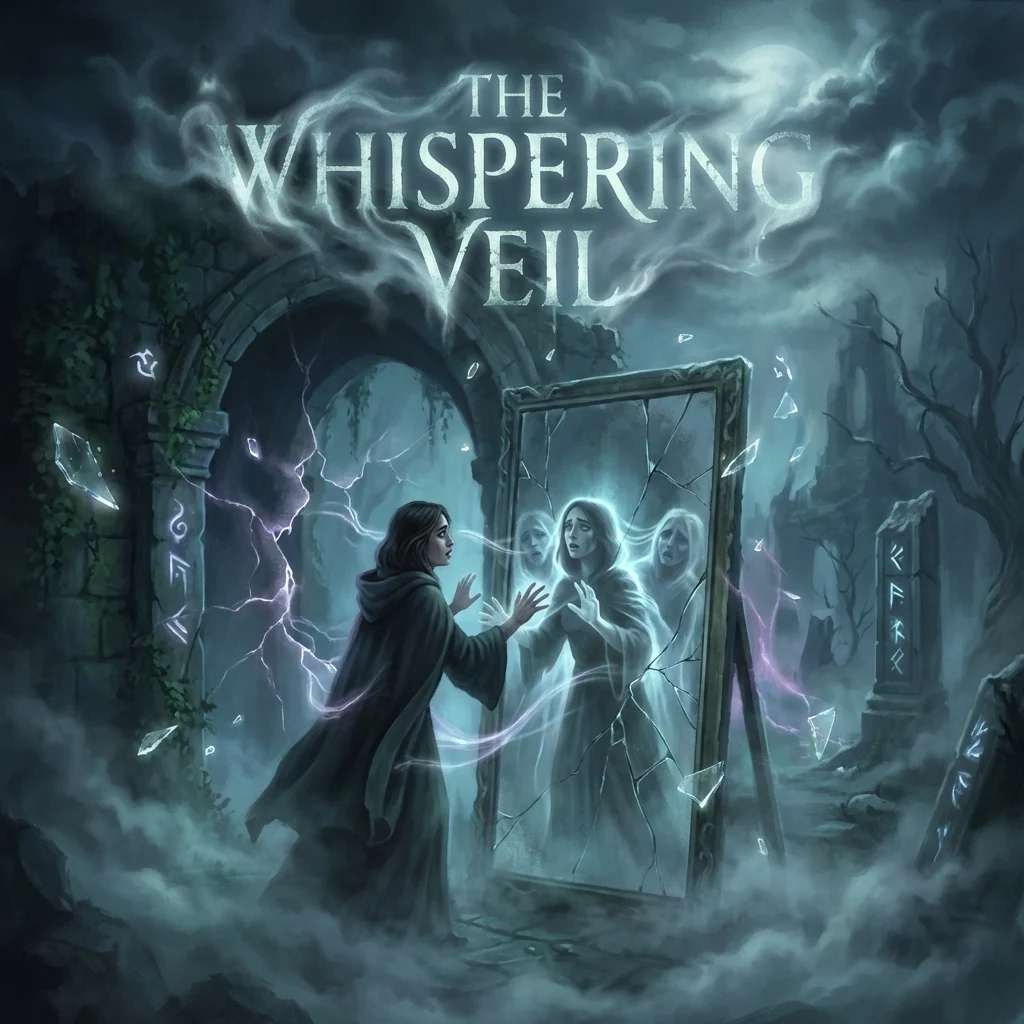
Elara had always felt the world was a fragile thing, like a pane of glass waiting for the right crack. She lived in the old Hawthorne House on the edge of Eldridge Hollow, a crumbling Victorian relic inherited from her eccentric grandmother. The townsfolk whispered about the place, calling it cursed, but Elara dismissed their tales as superstition. She was a rational woman, a librarian by trade, who preferred facts to folklore.
It started on a foggy autumn evening. Elara was sorting through her grandmother’s attic, dust motes dancing in the slivers of light piercing the grimy windows. Her fingers brushed against a peculiar veil—thin as spider silk, shimmering with an iridescence that defied the dimness. It was draped over a forgotten vanity mirror, half-concealed by yellowed linens. Curiosity piqued, she lifted it away.
The mirror’s surface rippled like water disturbed by a stone. Elara blinked, rubbing her eyes, convinced it was a trick of fatigue. But as she stared, faint whispers emanated from the glass, indistinct murmurs that tugged at the edges of her mind. She leaned closer, heart quickening. Shapes flickered within: shadowy figures moving in a world just beyond her own.
Shaking off the unease, Elara covered the mirror and descended to the kitchen. That night, sleep evaded her. Dreams wove through her subconscious—visions of ethereal beings pressing against invisible barriers, their hands outstretched, pleading silently.
The next morning, the whispers persisted, faint echoes in the house’s silence. Elara returned to the attic, drawn inexorably. Uncovered once more, the mirror revealed clearer images: a spectral woman in Victorian garb, her eyes hollow with longing. ‘Help us,’ the figure mouthed, though no sound escaped—or did it? Elara felt the words in her bones.
Intrigued despite herself, Elara researched the house’s history. Eldridge Hollow was built over an old ley line, locals claimed, a place where the veil between worlds thinned. Her grandmother had been a medium, shunned for her ‘delusions.’ Elara scoffed inwardly, yet the mirror’s pull grew stronger.
Days blurred into nights. The whispers evolved into voices—fragments of stories, pleas for release. Elara saw glimpses of lives unlived: a child lost to fever, a lover betrayed, soldiers fallen in forgotten wars. Each vision left her drained, a hollow ache in her chest. She began documenting them in a journal, rationalizing it as a psychological experiment.
One evening, as twilight bled into the room, a new figure appeared: her grandmother, younger, vibrant. ‘Elara, child, you’ve awakened it,’ the apparition said, voice clear as crystal. ‘The Hawthorne blood calls to the thin places.’ Elara gasped, pressing her palm to the glass. It was cool, unyielding, yet she felt a pulse beneath.
Her grandmother’s spirit recounted the tale: centuries ago, the house was erected on a nexus where realities overlapped. The veil, woven from spectral threads, sealed the breach. But neglect weakened it, and now the other side hungered for entry.
Elara’s skepticism cracked. She experienced poltergeist activity—books tumbling from shelves, doors slamming in empty halls. Shadows lengthened unnaturally, coalescing into forms that watched her from corners. Sleep brought nightmares of being pulled through the mirror into a twilight realm of endless fog and wailing souls.
Desperate for answers, Elara visited the town archives. Old records spoke of vanishings: entire families swallowed by the house every generation. Her great-aunt, her uncle—gone without trace. The pattern chilled her. Was she next?
The mirror’s allure intensified. Visions now showed the other side in vivid detail: a monochromatic landscape where time looped in torment. Spirits clustered at the veil’s edge, their desperation palpable. One, a young man with eyes like polished obsidian, locked gazes with her. ‘Join us,’ he urged. ‘It’s peaceful here.’
Elara resisted, but isolation gnawed at her. Friends distanced themselves after her distracted conversations; the job suffered as she fixated on the attic. Paranoia set in—were the shadows following her downstairs? Did the whispers echo in the library stacks?
A storm raged one night, thunder shaking the foundations. Lightning illuminated the attic, and the mirror blazed. The veil tore slightly, a rift allowing tendrils of fog to seep through. Elara felt the house groan, reality warping. She glimpsed the other world encroaching: furniture twisting, walls breathing.
Panic surged. She grabbed the veil, intending to redrape it, but hands—cold, insistent—gripped her wrists from the glass. Pulled forward, she fought, nails scraping the frame. Her grandmother reappeared: ‘Seal it with blood, Elara. Hawthorne blood.’
A letter from her grandmother, found tucked in the vanity drawer, confirmed it. The ritual: a willing sacrifice to mend the weave. Generations had done it, vanishing to preserve the world.
Tears streamed as Elara pricked her finger, blood dripping onto the veil. The rift shuddered, spirits howling in rage. But the hands released her, the fog receding. Exhaustion claimed her; she awoke on the floor, the mirror inert, veil intact.
Relief washed over her, mingled with grief. She had saved the world, at a cost to her sanity. The house fell silent, shadows retreating. Elara burned the journal, vowing silence.
Weeks passed. Normalcy returned, tentatively. Then, one misty morning, as she passed the attic stairs, a whisper slithered down: ‘Thank you, sister.’
Elara froze. The voice was her own.
She raced upstairs. The mirror stood covered, but uncovering it revealed not spirits, but her reflection—fractured, multiplied. Each version smirked, eyes glowing with otherworldly light. The rift hadn’t closed; it had widened within her.
Memories flooded back, recontextualizing everything. The ‘visions’ weren’t of the dead; they were echoes of her own fragmented soul, splintered when she, as a child, had torn the veil in a tantrum, causing her parents’ disappearance. Grandmother had lied to protect her, binding the fracture temporarily.
Now, the real her was on the other side, and this Elara was the intruder, the presence never meant to awaken fully. Every ‘spirit’ had been a piece of herself, begging for reunion. By ‘sealing’ it, she had merged further, dooming herself to haunt the thin place from within.
As neighbors noticed her absence, the house stood empty, veil pristine. But on foggy nights, whispers called from the windows, inviting the next Hawthorne to gaze too long.