
The fog clung to Millford like a shroud, muting the world into shades of gray as Elias Thorne stepped off the Greyhound bus. His boots splashed in shallow puddles, each step echoing the weight of twenty years’ absence. The town hadn’t changed much—same sagging porches, same flickering streetlamps, same oppressive silence that had haunted his dreams. Clara. Her name was a knife in his chest, sharp and unrelenting. She’d vanished on a night just like this, when they were kids playing by the river. No body, no clues, just endless questions that had driven him away.
Elias checked into the Millford Inn, a creaky relic with wallpaper peeling like old skin. The clerk, Mrs. Harrow, eyed him suspiciously. ‘Thorne boy, ain’t ya? Back for the old ghosts?’ He nodded curtly, taking the key to room 7. Alone, he unpacked a single photo: him and Clara, ten and eight, grinning by the water’s edge. Her eyes sparkled with mischief; his held a shadow even then.
Sleep evaded him. Fragments of memory surfaced—Clara’s laughter turning to screams, water churning dark and cold. He bolted upright, heart pounding. It was always the same: incomplete, maddening. Psychologists called it repressed trauma. Elias called it hell. He’d come back to end it, to find answers before the guilt consumed him whole.
Morning brought a leaden sky. Elias started at the old house on Elm Street, now boarded up, their childhood home sold off after the disappearance. The lock was rusted; a shoulder shove gained entry. Dust motes danced in slivers of light as he climbed the stairs to Clara’s room. The bedframe stood empty, posters faded to ghosts. Under the floorboards, as legend whispered, he pried with a crowbar from his suitcase. A small metal box. Inside: Clara’s diary, brittle pages filled with childish scrawl.
‘Dear diary, Elias is mad at me today. I broke his toy car. He yelled, said he’d never forgive me. But he will. Brothers always do.’ Entries grew darker. ‘Elias found the secret spot by the river. He says no one can know. Hargrove watches us funny.’ Mr. Hargrove, the neighbor, reclusive painter who’d died five years back. Elias’s pulse quickened. Had Clara stumbled on something?
He pocketed the diary and headed to the library, where microfilm archives yellowed with age. Old newspapers chronicled the search: ‘Local Girl Missing, Suspicions on Recluse.’ Hargrove had been questioned, alibi shaky. Elias’s father had always suspected him. A photo showed Hargrove by his studio window, staring toward the river.
Intuition pulled Elias to Hargrove’s old place, a crumbling Victorian two doors down. The gate creaked open; no lock. Inside, canvases stacked like accusations—dark landscapes, rivers swirling with menace, a child’s face half-submerged, eyes wide in terror. Elias’s stomach twisted. One painting bore a date: the night Clara vanished. Signed ‘H.’ Proof?
He rifled through drawers, finding sketches of Clara—not innocent portraits, but twisted, shadowed. A note scribbled: ‘Saw it all. The boy pushed. River took her.’ The boy. Elias? Or Hargrove projecting? Doubt gnawed. His memories flickered: arguing with Clara, her taunting him about the broken car, running to the river…
That afternoon, he tracked down Tommy Wilkes, childhood friend turned town drunk, nursing a beer at The Rusty Anchor. ‘Hargrove was creepy, man,’ Tommy slurred. ‘Always painting kids. After Clara, cops searched his place, found nothing. But he looked at you funny, Elias. Like he knew something.’ Elias pressed: ‘Did he?’ Tommy shrugged. ‘Heard he confessed to Father Michaels before dying. Absolution or whatever.’
Father Michaels, now retired, lived in a modest bungalow. The priest’s eyes were milky with cataracts but sharp with memory. ‘Hargrove carried a burden,’ he admitted over tea. ‘Spoke of witnessing a sin by the river. A boy’s rage, a sister’s fall. Said he’d protected the wrong soul.’ Elias’s hands trembled. ‘Me? Did he say me?’ Michaels shook his head. ‘Wouldn’t name names. Burden of secrecy.’
Nights blurred into obsession. Elias pored over the diary by lamplight. Clara’s words twisted in his mind: ‘Elias scared me today. Said if I tell, he’ll make me disappear.’ Had he threatened her? Memories clashed—no, it was Hargrove lurking. But why protect him? Elias dreamed of the river, hands pushing, splash, silence. He woke screaming.
He confronted the past head-on, trekking to the riverbank under moonlight. Weeds choked the path; the water rushed indifferent. Flashbacks assaulted him: Clara daring him to cross the old footbridge, rotten planks giving way. No—they’d argued, she ran, he chased. Voices in his head multiplied, accusing, denying.
Back at Hargrove’s, deeper search. A hidden panel behind a bookshelf revealed letters. ‘I saw you, boy. The shove. She hit her head on the rock before the current took her. I pulled you out, dazed. You begged me not to tell. I pitied you.’ Unsigned, but Hargrove’s hand. Elias staggered. It fit—the paintings, the looks, the secrecy.
But wait—the letter continued: ‘Years later, you came back once, asked if I remembered. I lied, said no. Guilt eats you, doesn’t it?’ Elias hadn’t come back. Or had he? Blackouts in his past, therapy sessions blank.
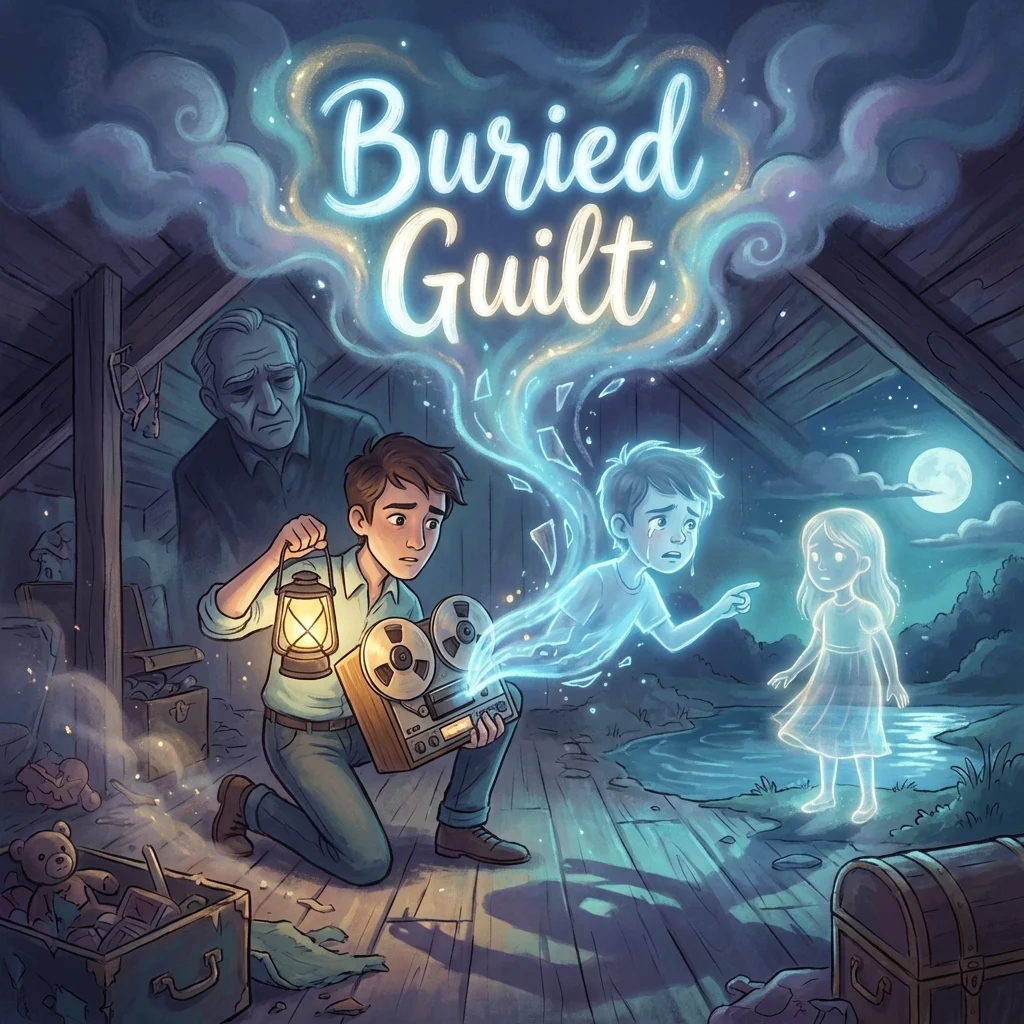
Intensity built to fever pitch. Elias returned to the Thorne house basement, where his father stored junk. Amid boxes, a tape recorder, labeled ‘Elias – age 12.’ He played it, breath held.
Static, then young Elias’s voice: ‘I didn’t mean to. She fell. Please, don’t tell. I’ll be good.’ Pause. Older voice—Hargrove? ‘Your secret’s safe, son. Go home. Forget.’
Elias collapsed. The pieces shattered and reformed. He’d repressed it all—the push in anger over the toy, her slip on mossy rocks, his panic. Hargrove had witnessed, covered for him, painted his torment. Every clue he’d chased was his own buried guilt manifesting, projecting onto the dead man. Clara’s diary hints were his threats forgotten; paintings his subconscious reflected.
He sat by the river at dawn, the fog lifting. No redemption, just truth. He whispered her name, finally free, as the water carried away the last shadows of denial.